

Best Grinding Machine Manufacturer for Precision Performance and Long Term Reliability
2026-08-19
In precision manufacturing, the difference between acceptable and exceptional often comes down to the grinding machine behind the finish. If you're searching for a partner that delivers both pinpoint accuracy and long-term dependability, WINNRUI CNC has earned its reputation as the go-to name. But what exactly sets their machines apart from the rest? Let's take a closer look.
Precision Is Built Before the Grinding Wheel Touches Metal
The real work of a precision grind happens long before sparks fly. A skilled operator will spend more time checking the workpiece seating, dressing the wheel profile, and letting the spindle reach thermal equilibrium than actually feeding the wheel into metal. Those quiet minutes matter because once the abrasive makes contact, every unresolved error in fixturing or runout gets pressed into the surface at micron scale.
Consider what happens when you skip pre-balancing a wheel or ignore a half-degree shift in the magnetic chuck. The grinder won't complain immediately, but the first pass leaves a telltale chatter pattern that no amount of spark-out can erase. Shops that consistently hit sub-thou tolerances treat the setup as a separate discipline: they map the wheel wear by feel, preload the workhead bearings, and pre-measure the blank with a tenths indicator before the first cut. The grinding itself becomes almost an afterthought—it simply confirms what the preparation already achieved.
This front-loading of accuracy also changes how you read a part. Instead of grinding, measuring, and hoping, you're validating a known coordinate system. The wheel path becomes a guided motion through a volume that was already characterized. That's why the best grinders rarely talk about the sparks or the finish; they talk about the dress interval, the fixture clamping force, and how long they let the coolant settle after startup. Because they know the metal never lies, but it only tells you what you told it first.
The Frame and Spindle Choices That Keep Tolerances from Drifting
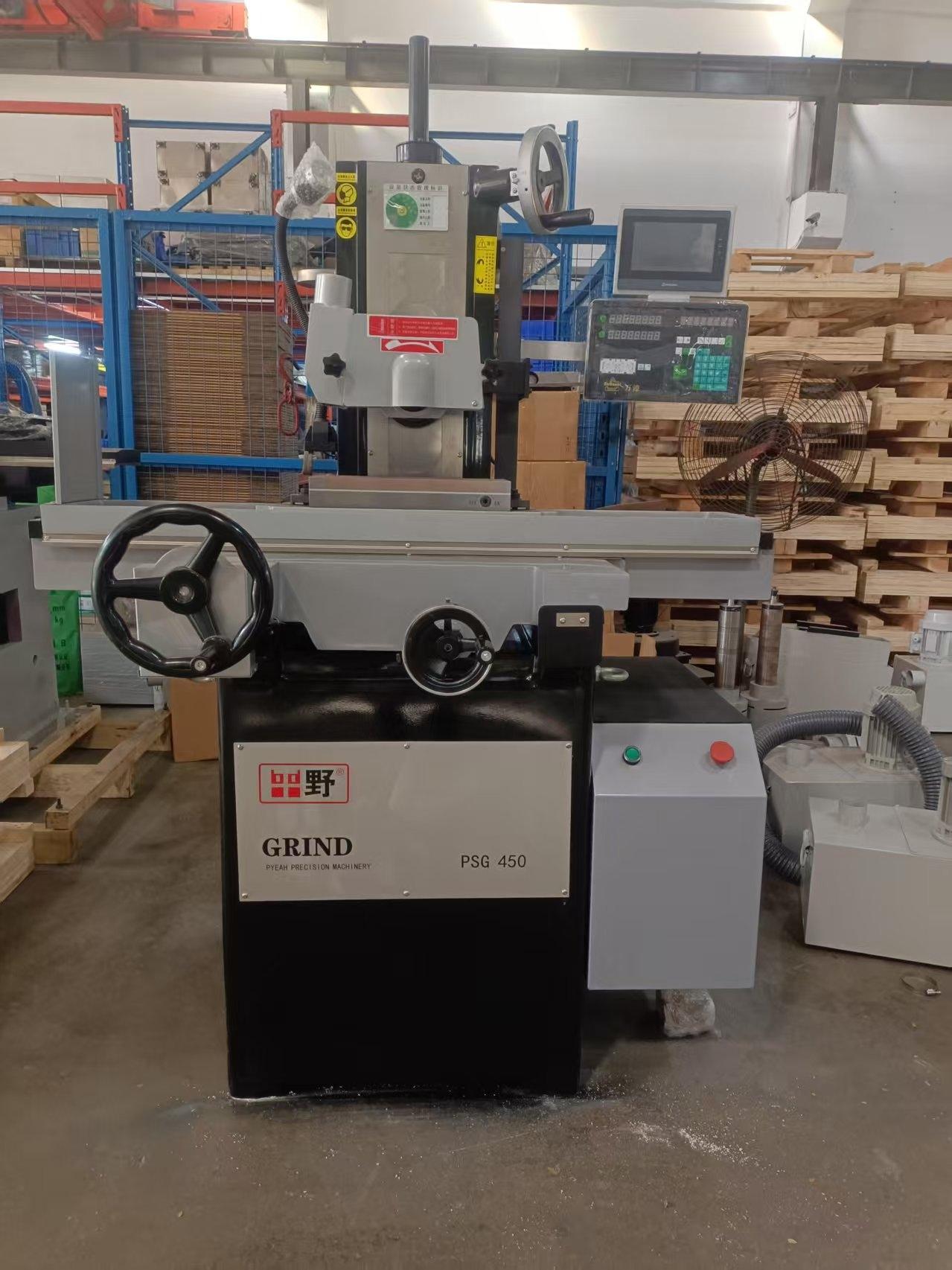
A machine's foundation does far more than hold parts together. Cast iron frames, especially those with stress-relieved ribbing, resist the slow creep caused by temperature swings and cutting forces. When the bed stays dimensionally quiet, the spindle's centerline doesn't wander, so hole positions and bore diameters hold hour after hour.
Spindle selection matters just as much as frame mass. High-preload angular contact bearings in a stiff cartridge reduce radial play to microns, while grease with low bleed keeps heat from distorting the nose. Pairing a short, thick spindle shaft with a symmetrical housing means thermal growth pushes evenly outward instead of tilting the tool tip.
The real trick is the interface. A ground taper that seats the toolholder without any radial mismatch, plus a drawbar that clamps with consistent force, prevents micro-slippage that would otherwise shift the effective length. Once that stack-up is locked, long runs stop showing that slow tolerance drift everyone hates.
What Fifteen Years of Daily Grinding Actually Does to a Machine
After fifteen years of daily grinding, the most visible change isn't a single catastrophic failure but a slow accumulation of wear that reshapes the machine's character. The burr edges that once sliced through coffee beans with crisp precision have dulled into rounded shoulders, producing more fines and a coarser, less predictable particle distribution. Bearings that spun silently now emit a low-frequency hum, the result of microscopic pitting and the gradual breakdown of lubricant into a gritty paste. Springs lose their snap, so the grind adjustment dial drifts slightly between sessions, forcing the user to compensate for a machine that no longer holds a setting like it used to.
Internally, the constant vibration and thermal cycling work like a slow-motion earthquake. Solder joints on the control board develop hairline cracks, causing intermittent power drops that are hard to diagnose because they only appear after the machine has been running for twenty minutes. The plastic housing around the grind chamber, once rigid, becomes brittle from repeated heating and cooling, leading to micro-fractures that let fine coffee dust seep into areas never designed to see it. A thin film of coffee oils and mineral scale builds up in the chute, reducing throughput even when the burrs are clean—a hidden tax on every single dose.
Yet the machine doesn't simply degrade uniformly; it adapts in ways that blur the line between wear and customization. The burrs, worn asymmetrically from the user's habitual wrist motion or bean loading pattern, create a signature grind profile that no factory-new unit can replicate. The motor's start-up lag lengthens from 0.3 seconds to nearly a full second, changing the sound from a confident whir to a hesitant groan that regular users learn to read as a cue to adjust their workflow. In the end, fifteen years of daily grinding doesn't just break a machine—it teaches it a kind of mechanical memory, where every flaw is a record of ten thousand mornings, and every quirk is a fingerprint of the hands that fed it.
Holding Two Microns After Back-to-Back Shifts Without Rework
Two microns is the kind of tolerance that makes or breaks a precision assembly. Run after run, the shop floor sees thermal drift, insert wear, and operator fatigue eat away at dimensional stability. But after back-to-back shifts on the same machine, the bores still measure within 2 microns of nominal—no offsets tweaked mid-run, no parts sent back for rework.
The process holds because the setup was dialed in before the first chip was cut. Tool life is mapped to the actual cut time, coolant temperature stays within a narrow band, and the in-process probe checks every tenth part without stopping the cycle. Operators follow the same hand-off routine between shifts, so nothing gets lost in the changeover. It’s not luck; it’s the result of controlling the variables that usually go unnoticed until a dimension drifts.
When the final inspection report shows zero rework across both shifts, the payoff goes beyond the scrap bin staying empty. Downstream assembly doesn't wait, and the next job starts on time. Two microns becomes a baseline, not a goal.
When Operators Change but Surface Finish Stays the Same
The real test of a well-dialed process isn't what happens when the star machinist is on shift—it's what happens when they hand the job to someone new. If the surface finish holds steady without a flurry of adjustments, the setup is doing its job.
That stability usually comes from removing guesswork. Feeds and speeds are pinned down, insert grades are specified, and the tool change interval is set by part count rather than feel. Even the order of operations gets written down, not passed along verbally.
Operators still matter, of course. They're the ones who notice the subtle hum of a bearing going bad or the faint lines that suggest the insert is past its prime. But those observations happen on top of a baseline that doesn't shift with the shift change. That's how a shop keeps the finish consistent when the people at the machine don't stay the same.
Mechanical Simplicity as a Long-Term Reliability Strategy
The appeal of mechanical simplicity isn't just about cutting costs—it's a deliberate bet on endurance. Every additional component introduces another potential failure point, another tolerance to drift, another interface where wear or misalignment can occur. By stripping a system down to its essential moving parts, engineers reduce the statistical likelihood of breakdown and make the remaining elements easier to inspect and understand.
This approach pays off in real-world conditions where spare parts are scarce or maintenance intervals are long. A mechanism with fewer linkages, fewer seals, and fewer electronic dependencies can often tolerate dirt, temperature swings, and operator variability without losing function. When something does go wrong, the fault is usually easier to isolate because the system's behavior isn't hidden behind layers of complexity.
Simplicity also extends the useful life of equipment. Upgrades and repairs become less invasive when the core architecture is straightforward. Instead of chasing the latest modular add-ons or relying on proprietary control loops, designers can focus on making a handful of robust components work exceptionally well together. That kind of clarity often translates into decades of service rather than years.
FAQ
Focus on spindle design, thermal stability, and how the builder controls vibration. A manufacturer that offers test cuts with documented roundness and surface finish data is usually more credible than one that only lists tolerance ranges on a brochure.
Initial accuracy can be achieved by careful assembly, but long-term reliability depends on wear-resistant guideways, protected linear components, and a base casting that resists distortion over years of thermal cycling. Ask for examples of machines still holding tolerance after ten or fifteen years in production.
Even a well-built grinder needs periodic alignment, dressing system calibration, and software updates. A responsive support team that can remotely diagnose servo or probing issues prevents small deviations from becoming scrap rates. Check whether they stock critical spindles and drives locally.
Heat from the spindle, motors, and coolant can shift dimensions by several microns. Machines with temperature-controlled coolant, core-cooled ballscrews, or symmetric frame designs keep geometry stable during long batches. Ask about warm-up cycles and how they compensate for ambient temperature changes.
Request a capability study on your actual workpiece, including roundness, cylindricity, and Ra values. Also inspect the machine's way scraping pattern, bearing preload specifications, and use of hydrostatic or air bearings. A transparent builder will share inspection reports and allow a visit to a running installation.
Look for competency in cylindrical, surface, and centerless grinding, as well as ID/OD combinations. A manufacturer that understands wheel dressing strategies, in-process gauging, and automation interfaces can adapt one platform to various part families, which often reduces total lifecycle cost.
Conclusion
Real grinding accuracy does not start when the abrasive meets the part. It is decided earlier, in casting stress relief, hand-scraped guideways, and the way a spindle housing is aligned before any load is applied. The right manufacturer treats the machine frame and spindle as the actual measuring system, not just the servo loop around them. That is why some shops can hold tolerances for a decade while others see drift within months. Daily grinding for fifteen years is a brutal test: coolant eats at seals, micro-vibrations loosen bolts, and thermal cycles quietly bend even solid castings. A builder that designs for that reality uses thicker sections, fewer bolted joints, and keeps the spindle bearings oversized rather than just adequate.
What separates a dependable grinding machine from a fragile one becomes obvious after back-to-back shifts. Holding two microns without rework is not a software trick; it comes from predictable thermal behavior, stable way lubrication, and enough mass to ignore ambient changes. When three different operators load parts across a week and surface finish stays the same, that points to simple, repeatable controls and mechanical setup rather than constant compensation. The most convincing long-term reliability strategy is often the least praised one: mechanical simplicity. Fewer linear motors, fewer proprietary sensors, fewer failure modes. That approach costs less to maintain, is easier to repair, and keeps accuracy honest. The best grinding machine manufacturer, then, does not chase complexity for a brochure. It builds a rigid, boringly consistent machine that still holds tolerance long after the warranty is forgotten.
Contact Us
Contact Person: Tim
Email: [email protected]
Tel/WhatsApp: +86 15522553731
Website: https://www.winnrui-cnc.com/