

China Garage Door Manufacturing Insights for Global Buyers
2026-08-16
Global buyers often assume all Chinese garage door factories are the same—until a shipment arrives with uneven welds and weak springs. That’s exactly what NORTON works to prevent. Drawing on years of on-the-ground production insights, this blog unpacks the factors that separate dependable manufacturers from risky ones, and how to spot them before you sign a contract.
The Real Cost of Chinese Garage Doors: Beyond the Sticker Price
Many buyers fixate on the $500–$800 list price for a Chinese-made garage door, but that number rarely survives contact with a freight quote. You still have to cover port fees, customs brokerage, inland trucking, and often a liftgate service because residential curbsides aren't dock-height. Depending on the port and your distance from it, those charges can add $300–$700 before the door even reaches your driveway. Then there's the matter of local code compliance—some doors arrive without the required wind-load reinforcement or safety photo-eye brackets, so you end up buying those parts separately anyway.
The next hidden cost is in the materials that don't show up on a spec sheet. A low sticker price usually means thinner steel—often 24 or 25 gauge instead of the 26 gauge or thicker common in domestic doors—plus fewer struts and a lighter track system. Spring cycles are another giveaway: many budget imports come with 5,000-cycle springs, while quality doors use 10,000 cycles or more. You won't notice that on day one, but it translates to a spring replacement in three to five years instead of ten to fifteen. Powder coating may also be thinner, leaving the door more vulnerable to scratches and rust in coastal or snowy climates.
Then come the operational headaches. Remote controls and wall buttons from Chinese manufacturers sometimes use rolling-code frequencies that conflict with North American garage door openers, forcing you to install a separate receiver. Replacement panels, hinges, and rollers are rarely stocked by local dealers, so a damaged section can mean a six-week wait for a container shipment—or replacing the whole door. When you factor in the value of your time, potential rework, and the shorter service life of key components, the true cost often lands within a few hundred dollars of a locally supported door. That's the part the sticker price never mentions.
Inside China's Automated Production Lines for Garage Doors
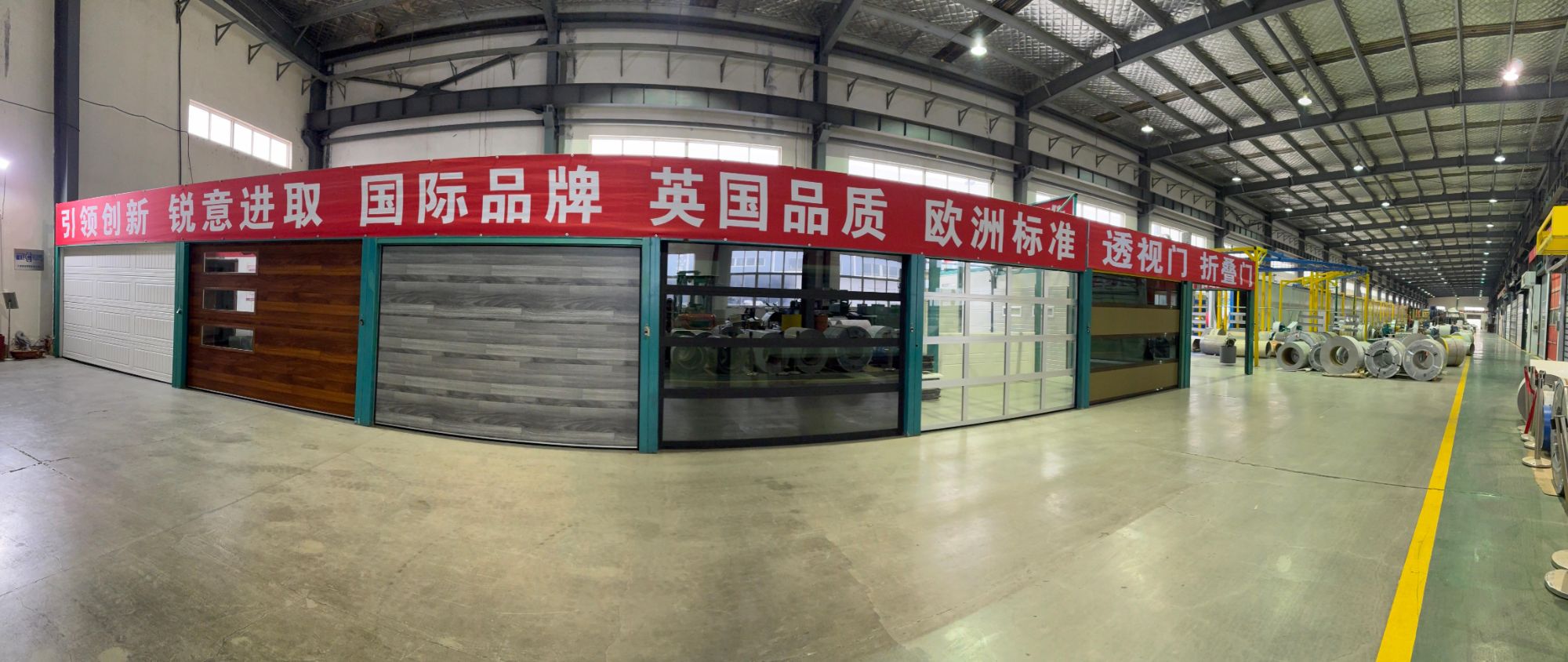
Step past the dust-free entry and the first thing you notice is how quiet the line runs. A decoiler feeds 0.4-millimeter galvanized steel into a roll former that bends, notches, and cuts each garage door panel in one continuous pass. No hammering, no sparks—just the low hum of servos. Overhead, a six-axis robot picks up a finished panel, rotates it under a bank of cameras, and places it onto a buffered conveyor without ever breaking stride.
Around the corner, the panels move through a pre-treatment rinse, then into a powder coating booth where charged paint particles wrap evenly around every groove. From there, an automated assembly cell presses hinge brackets into pre-punched holes and drives screws to torque specs stored in the line's controller. Changeover for a different door size happens with a touchscreen recipe change, not a wrench. At the end, a laser-etched code links each door to its full production history—coil batch, coating lot, even the operator who approved the final check.
Customizing Without Compromise: What Chinese Makers Actually Offer
Customization is often framed as a trade-off: you can have it cheap, fast, or exactly to spec, but not all three. Chinese manufacturers have quietly dismantled that assumption. For them, adjusting a product to fit a specific market, brand, or use case is not a special request—it's the default way of working. You can ask for a different PCB layout, a custom firmware build, swapped materials, or even a completely new enclosure shape, and the response is rarely a list of added fees. It's a revised sample timeline, usually measured in days rather than weeks.
What actually sets many of these makers apart is the direct access to engineers who treat your project as their own. Instead of a salesperson noting your changes and relaying them through layers, you're often chatting with the person who will modify the CAD file or tweak the injection mold. They'll suggest cheaper component alternatives, flag potential assembly issues, and sometimes push back with a better idea. That kind of back-and-forth is rare with large contract manufacturers, but it's standard practice among smaller, agile Chinese factories.
The phrase without compromise becomes real when you see how production lines are structured. Short runs don't break their workflow. A batch of 100 units with custom branding and slightly altered specs moves through the same process as a 10,000-unit order. There's no minimum order quantity penalty that forces you to accept a product that's almost right. You get the exact product you need, at a cost and speed that used to belong only to off-the-shelf alternatives.
Quality Checks That Matter: A Buyer's Guide to Chinese Factory Audits
Many buyers assume a factory audit is just a formality until a shipment arrives with mismatched thread colors or weak welds. The audits that actually prevent problems focus on three layers: incoming material verification, in-process controls, and final inspection against your approved sample. Ask to see the raw material certificates for anything load-bearing or skin-contact, and don't accept a yes/no checklist. Watch how operators handle defective pieces they find mid-line.
Another overlooked check is the factory's own quality documentation. If they can't show you a recent internal rejection log or rework records, that's a red flag, not a minor paperwork gap. During the walkthrough, compare a random carton from the packing area against your spec sheet, not just the display sample. Factories often polish the showpiece but rush the run, and catching a sealed carton tells you more about real output than any conference-room presentation.
Tie the audit to your product's specific failure modes. Generic audits miss the point. If you're buying electronics, verify ESD protection and solder joint sampling. If textiles, check seam strength and colorfastness under the factory's actual lighting. A useful audit report won't just list non-conformities, it will recommend containment actions and a date for recheck. Walk away from any auditor who offers a pass without visiting the production floor during working hours.
From Ningbo to Your Warehouse: Navigating Logistics for Bulk Orders
Getting a bulk order out of Ningbo isn't just about booking a container and hoping for the best. The port complex at Ningbo-Zhoushan handles a massive share of China's exports, which means plenty of sailing options but also fierce competition for space during peak months. For smaller bulk orders, consolidating with other buyers under LCL can trim costs, while full container loads offer more control over handling and scheduling. Before you commit to a freight forwarder, ask for a breakdown of the route: direct sailings to major hubs like Rotterdam or Los Angeles are faster, but transshipment via Singapore or Busan might knock 15-20% off the rate if your timeline can absorb an extra week.
Once your goods leave the factory, the real coordination begins. A forwarder with a Ningbo-based office can pick up from the supplier, arrange export clearance, and consolidate cargo at a warehouse near the Beilun or Chuanshan terminals. Make sure the commercial invoice and packing list match exactly what's loaded - discrepancies are a common cause of customs holds at both ends. Also, keep an eye on Chinese holidays: the weeks around Spring Festival and Golden Week see a crunch on trucking and container availability, so booking space three to four weeks ahead is not overkill. If you're shipping multiple suppliers, using a single consolidation warehouse before the port cuts down on last-minute chaos.
On the receiving end, don't leave unloading and onward trucking as an afterthought. Confirm with your destination warehouse whether they need a drop-off appointment, and check if the container can be delivered directly or must be transloaded to a domestic trailer. Palletizing goods at the Ningbo side may cost a bit more, but it speeds up unloading and reduces damage claims. Finally, carry marine insurance from door to door rather than just port to port - bulk orders represent a significant cash outlay, and the small premium is worth the peace of mind when a typhoon delays a vessel or a container gets flagged for inspection.
Smart Garage Doors: China's Quiet Push Into IoT and Home Integration
Walk through a recently built residential complex in Shenzhen or Hangzhou, and you might notice garage doors that open before the car even slows down. The mechanism behind this isn't a simple remote control but a mesh of local IoT sensors, edge computing nodes, and regional cloud services tied to a homeowner's broader smart home setup. What's notable is how quietly this shift has happened, driven less by flashy product launches and more by the practical needs of dense urban living and factories that already produce most of the world's connected hardware.
Chinese manufacturers have moved beyond basic motorized openers to embed door controllers with energy monitoring, usage pattern learning, and integration layers for platforms like Xiaomi Home, Huawei HiLink, and Alibaba Genie. The real innovation isn't in any single gadget—it's in the way these doors become one node in a property-wide automation flow. For example, a door can trigger hallway lights, adjust the thermostat, or log entry times for elderly family members, all without a separate app for each action. This integration is often handled by low-power wide-area protocols such as NB-IoT or Bluetooth mesh, which keep costs down while extending battery life to years rather than months.
The quiet push also reflects a different approach to home automation compared to Western markets. Instead of focusing on voice assistants or standalone smart locks, the emphasis here is on infrastructure-level connectivity that works reliably in apartment blocks with hundreds of garage units. Property developers bundle these systems into new builds, while retrofitters can buy retrofit kits that attach to existing doors and connect to a building's management network. The result is a garage door that rarely draws attention—it simply opens, closes, and shares data with the rest of the home, disappearing into the background of daily life. That invisibility, perhaps, is the strongest sign of how far IoT has come in China's residential sector.
FAQ
Many midsize factories won't blink at mixing sectional doors, motors, and spare parts in one 20GP or 40HQ as long as SKU counts stay manageable. They often palletize hardware kits separately and wrap panels with reinforced corners; just confirm the loading plan before deposit to avoid last-minute cubic-meter surprises.
Standard white or wood-grain steel doors can ship in 15–25 days after deposit, while fully custom sizes, RAL colors, or non-standard track systems usually add 10–18 days. Factories with in-house powder coating lines tend to keep color changes faster than those outsourcing coating.
Many export-focused plants hold CE for European orders and can arrange UL or ETL through partner labs for North America, but not every factory has both. Ask for the actual certificate number and run it on the lab's database; a surprising number of quotes mention "CE available" without a valid file.
Look beyond the door panel price per square meter. Compare steel thickness and coating type, track gauge, spring cycle rating, packaging, whether the quote includes rollers, hinges, cables, and the exact Incoterm. Two identical-looking 40HQ quotes can differ by $1,200 when one omits bottom seals and spring hardware.
Usually they use 0.25–0.35mm galvanized steel skin with polyurethane foam density around 38–42 kg/m³. Cheaper doors dip to 0.20mm or use EPS foam, which reduces panel strength and insulation. Mid-range buyers often specify 0.30mm steel plus 40kg/m³ PU to stay competitive without field failures.
They forget that garage door panels are long and bulky, so per-unit freight costs can exceed the factory price if the order doesn't fill a container. Other common errors include not confirming whether tracks are bundled separately, choosing unbraced packaging for sea freight, and missing the destination port's oversized cargo handling fees.
Yes, most export-oriented factories are comfortable with neutral cartons, private logos, and custom instruction manuals. Some charge a small plate or printing fee, while others include it at no cost above a modest order volume; just ask for a sample of the manual layout to avoid layout mistakes in the first production run.
More plants now offer doors pre-fitted with Wi-Fi or RF receivers, battery backup, and app-controlled openers. The better suppliers test compatibility with popular ecosystems like Tuya or SmartThings, but buyers should request a demo video of the actual app interface, because some "smart" kits are just basic remote controls with a generic app skin.
Conclusion
For global buyers, the true cost of a Chinese garage door rarely ends at the quoted unit price. Tooling, packaging, certification, and the risk of rework all stack up quickly if a supplier's quality system isn't scrutinized early. Walking through a modern Ningbo factory, you'll see automated roll-forming and robotic welding lines that keep labor costs low and consistency high—but only when the equipment is properly maintained and calibrated. The best suppliers welcome a pre-shipment audit, letting you check zinc coating thickness, spring cycle ratings, and hinge alignment before containers are sealed.
Customization is where Chinese manufacturers genuinely shine, but it demands clear specs. Beyond panel profiles and colors, many now offer smart garage door controllers that tie into Tuya, Alexa, or Google Home ecosystems—often at a fraction of Western pricing. Logistics matter just as much as the product: consolidating mixed SKUs from Ningbo to a single warehouse cuts per-unit freight, while realistic lead times account for Chinese New Year shutdowns. Buyers who treat the relationship as a long-term engineering partnership rather than a one-off transaction find that China's garage door sector can deliver both margin and reliability. The key is verifying every claim on the factory floor, not in a brochure.
Contact Us
Contact Person: Cyril He
Email: [email protected]
Tel/WhatsApp: 8613969697307
Website: https://cqyqgd.en.alibaba.com/