

China Servo Motor Magnets: Powering Next-Gen Automation and Robotics
2026-09-04
Walk through any modern robotics lab in Shanghai or Dongguan and you'll hear the same quiet challenge: how to squeeze more torque from a smaller motor without sacrificing precision. The answer often lies in China servo motor magnets—dense, thermally resilient rare-earth components that determine whether a robotic joint hits its mark or drifts out of tolerance. As next-gen automation pushes cycle times and payloads higher, off-the-shelf magnets no longer cut it. DAWA has built its reputation on engineering magnets that hold their magnetic strength under stress, giving integrators one less variable to worry about. Here's why that matters for your next motion project.
China’s Magnetic Edge in Servo Torque Density
China’s lead in servo torque density is less about a single breakthrough and more about how magnetic materials, lamination stacks, and winding techniques are tuned as one system. Domestic manufacturers draw on tightly integrated rare-earth supply chains to push remanence and coercivity higher without waiting on imported magnet grades. This lets engineers reduce rotor inertia while increasing air-gap flux, so a smaller frame can deliver the continuous torque that once required a much larger motor.
The practical effect shows up in machine tools, robotics, and linear motion stages where space is constrained but dynamic response cannot be sacrificed. Chinese servo builders often pair custom magnet geometry with aggressive thermal design, allowing peak torque to be sustained longer before derating. The result is a motor that feels stiffer under load, with less cogging and a broader constant-power speed range than similarly rated alternatives.
Demagnetization Curves That Define Robot Durability
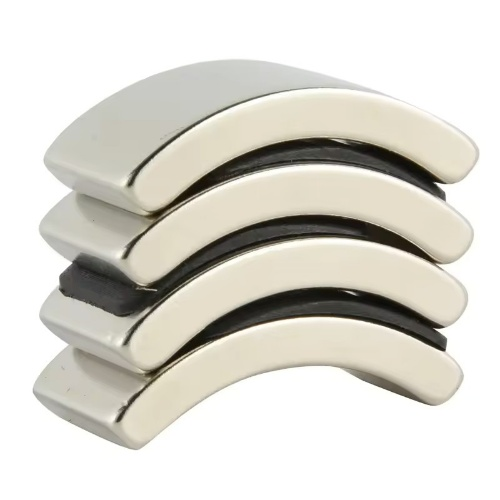
For the permanent-magnet motors inside robot joints, the demagnetization curve is more than a datasheet graph—it sets the boundary between a machine that holds its torque over years of abuse and one that quietly loses grip. When a joint pushes against a stalled load or runs hot during a long shift, the magnets inside can be pushed toward the knee of their B-H curve. Cross that knee even briefly, and the loss in magnetic flux is permanent, showing up as sloppy positioning, higher current draw, and heat that accelerates every other wear mechanism.
Not all magnet grades fail the same way. A high-coercivity grade keeps its curve almost linear from room temperature up to the motor's peak winding temperature, giving designers room to push phase current without worrying about partial demagnetization. Cheaper grades, by contrast, show a knee that creeps closer to the operating point as temperature rises—so a robot that works fine on a cool test bench can lose noticeable strength after repeated hot stalls. The curve shape, not just the listed energy product, is what determines whether a compact actuator can survive its intended duty cycle.
Durability testing that relies only on torque output can miss early damage. A more revealing approach is to re-map the demagnetization curve after a set of thermal and overload cycles, looking for a shifted knee or a drop in the linear slope. Those changes appear long before the robot shows an obvious fault, giving engineers a way to estimate how many months of real work the magnets can absorb before performance falls below spec. That is why the curve itself, rather than any single rating, often becomes the clearest predictor of a robot's useful life.
Why Magnet Tolerances Decide Automation Costs
In automated assembly lines, magnets often serve as the silent referees for positioning, holding, or triggering sensors. A batch of magnets that arrives slightly oversized or undersized won't announce itself; it will simply cause a gripper to miss its mark by half a millimeter or a reed switch to fire inconsistently. Those half-millimeter errors compound across thousands of cycles, turning a routine production run into a parade of micro-stops, resets, and rejected parts.
Tightening magnet tolerances is less about achieving perfection on a data sheet and more about removing variability from the process. When every magnet seats flush, trips its sensor at the same field strength, and releases cleanly, the automation can run at designed speeds without constant human intervention. The upfront cost of higher-grade magnets usually gets repaid within weeks through lower scrap rates, fewer line stoppages, and reduced wear on tooling that no longer has to compensate for dimensional drift.
From Rare Earth Powder to Precision Servo Rotors
The journey starts with a carefully measured blend of neodymium, iron, boron, and trace additives like dysprosium or terbium. Powder particle size and shape directly influence magnetic alignment during the pressing stage, so milling is controlled to a narrow distribution. Even minor deviations in composition can shift coercivity or remanence, which later shows up as torque ripple or thermal instability in the finished rotor.
That powder is then compacted under a magnetic field to lock in the preferred orientation, followed by high-temperature sintering in a vacuum or inert atmosphere. The resulting magnet blanks are far from ready—they are ground, sliced, and finished to micron-level tolerances using diamond tooling because the material is extremely hard and brittle. Protective coatings, typically nickel or epoxy, are applied to guard against corrosion from humidity or aggressive environments.
After magnetization, each magnet segment is bonded or mechanically retained onto a laminated rotor core. The assembly is then dynamically balanced, sometimes to within fractions of a gram-millimeter, because at high RPM even tiny mass asymmetries create vibration. The finished rotor slots into a servo motor where its precise magnetic field translates into smooth, responsive motion control for robotics, CNC axes, and automated guided vehicles.
Thermal Limits Push Servo Magnets Into New Territory
For years, servo motor designers treated magnet temperature as a hard ceiling. Standard neodymium-iron-boron grades begin losing useful flux around 80°C, and even high-coercivity variants rarely stay stable past 150°C without aggressive cooling. That ceiling is now moving. Demanding applications in downhole tools, electric aircraft actuators, and compact robotics are forcing engineers to rethink rotor materials and thermal paths rather than simply derating the motor.
Samarium-cobalt has re-emerged as a practical solution, not just an exotic option. Modern grades hold coercivity at 300°C and beyond, with reversible losses under 5% across a wide band. The trade-off has always been lower remanence and higher cost, but new magnet segmentation and flux-focusing rotor geometries narrow the gap. Some shops now run hybrid rotors: SmCo in the hottest zones near the air gap and NdFeB in cooler sections, squeezing more torque per package without crossing the thermal cliff.
Thermal modeling has also shifted from static worst-case charts to transient, mission-specific profiles. Instead of assuming a uniform 180°C, designers map hot spots in real time and place thermal barriers or directed cooling only where demagnetization actually starts. This lets servo motors operate continuously in territory that used to trigger immediate shutdowns—not by brute-force cooling, but by knowing exactly which magnet segment will fail first and designing around it.
Next-Gen Robotics Demand More Than Neodymium
Most conversations about robotics still circle around neodymium-based magnets, but the next wave of machines is already stretching those assumptions. High-precision arms, mobile manipulators, and humanoid prototypes are pushing motors into tighter thermal envelopes and higher torque densities. Neodymium-iron-boron remains unrivaled for raw magnetic strength at room temperature, yet it starts to fade well before the temperatures some actuators now reach. That gap is forcing engineers to look past a single-material solution and rethink how motors, gearboxes, and feedback systems work together.
The real bottleneck isn't just performance—it's resilience. A robot designed around one magnet chemistry inherits every supply shock tied to that material. Mines, processing quotas, and export shifts can stall a production line overnight. So newer designs are mixing approaches: pairing smaller neodymium magnets with ferrite or samarium-cobalt in hybrid rotors, or dropping permanent magnets altogether for switched reluctance and synchronous reluctance topologies. Some teams are even testing iron-nitride compounds that avoid rare earths entirely. None of these replacements wins on every metric, but they let manufacturers match the material to the task instead of forcing every joint to depend on the same element.
That shift is also changing how robots are built and maintained. Modular actuators can be swapped or upgraded without redesigned the whole limb, and sensor-rich control loops compensate for magnets with slightly lower energy products. Recyclability is gaining traction too—recovering neodymium from retired machines is becoming cheaper than opening new mines in some regions. The result is a field where the label "rare earth-free" matters less than pragmatic redundancy. Next-gen robotics won't abandon neodymium, but they'll stop treating it as the only path to motion.
FAQ
China pairs large-scale rare earth access with advanced sintering and grain boundary diffusion techniques, so magnets can be produced with consistent magnetic properties at volumes that global automation projects demand. The local supply chain also shortens lead times for custom grades like N52 or high-coercivity variants needed in compact servo motors.
Higher remanence and coercivity allow designers to shrink the rotor while keeping or boosting torque output. That translates into lighter robotic joints and faster acceleration without sacrificing holding force, which is critical for collaborative robots and high-speed pick-and-place systems.
Servo motors in automation often run hot during continuous duty cycles. Chinese manufacturers increasingly use dysprosium or terbium grain boundary diffusion to raise the maximum operating temperature without relying on thick protective coatings. This keeps demagnetization risk low even when peak temperatures exceed 150°C.
Beyond standard arc and block shapes, suppliers offer segmented magnets, skewed magnetization patterns, and tight dimensional tolerances down to ±0.03 mm. These options help reduce cogging torque and improve smooth motion control in direct-drive robot arms and linear actuators.
Most serious suppliers perform 100% magnetic flux inspection, salt spray testing for coatings, and batch-level thermal demagnetization tests. Reports often include BH curve data and flux consistency charts so buyers can validate rotor performance before assembly into servo motors.
Neodymium iron boron grades from N42SH to N52UH are common, with high-intrinsic coercivity variants chosen for motors that must survive high reverse fields. Samarium cobalt options also exist for extreme temperature or corrosion-prone environments, though they cost more and are used selectively.
Yes, many direct-drive actuators rely on thin-walled ring magnets with multipole magnetization. Chinese factories now produce these with consistent pole pitch and minimal flux leakage, enabling frameless torque motors that fit into tight robot joint envelopes while maintaining precise position control.
Conclusion
Inside a compact servo motor on a modern assembly robot, the rotor magnets pack enough flux to hold a small car. That is the quiet achievement of China's rare earth magnet industry, which controls the full chain from mined neodymium-praseodymium oxide to precision-ground rotor segments. The country's edge is not just raw material volume but the ability to hit N52-grade energy products while keeping coercivity high enough to survive repeated short-circuit pulses. Demagnetization curves published by Chinese magnet makers now show knee points that sit well beyond typical servo operating temperatures, giving robot designers headroom for sudden overloads. Tolerances matter just as much -- a 0.02 mm variation in magnet thickness can shift cogging torque enough to require larger bearings or more complex drives. By holding dimensions tighter than the industry norm, Chinese suppliers reduce scrap and trim automation system costs without sacrificing torque density.
Thermal stability is the next battleground. Standard neodymium magnets lose coercivity quickly beyond 150°C, yet next-gen collaborative robots and exoskeletons push servos into hotter, denser enclosures. Chinese producers are increasingly blending dysprosium and terbium into grain boundary diffusion processes, preserving flux at 180°C or higher while cutting rare heavy rare earth use. Some are experimenting with samarium-cobalt and anisotropic bonded hybrids for applications where linear demagnetization behavior trumps raw energy product. Precision rotor assembly has moved from hand-stacked arc segments to automated glue-dosing and in-line Hall probe mapping, letting a rotor leave the factory with a measured field waveform accurate to under 1%. For robot builders, that means less tuning on the line and predictable performance over a decade of start-stop motion. As automation moves into surgery, logistics, and humanoid platforms, China's servo magnet supply chain is no longer just the low-cost option -- it is becoming the reference for what a durable, thermally honest rotor should look like.
Contact Us
Contact Person: Kelvin Lo
Email: [email protected]
Tel/WhatsApp: 0769-88561131
Website: https://dawamagnetic.com/