

Custom Roller Conveyor Shot Blasting Machine Manufacturer Delivers Tailored Surface Preparation Systems
2026-08-16
What if your shot blasting line could handle odd-sized parts, heavy loads, and strict deadlines without compromises? That's the idea behind a custom roller conveyor shot blasting machine, and it's exactly what PuHua builds. Instead of forcing your workflow into standard equipment, PuHua engineers systems around your parts, production pace, and surface finish targets. In this article, we'll look at why tailored surface preparation pays off and what to expect from a manufacturer that puts your process first.
How Roller Conveyor Shot Blasting Adapts to Your Production Line
Roller conveyor shot blasting slots into a production line with far less friction than a batch cabinet. The conveyor speed can be tuned to match the pace of your existing cutting, welding, or machining stations, so parts move continuously rather than piling up at the blast stage. Roller spacing and blast wheel angles are set once for the work envelope, then adjusted only when a new family of parts comes through.
The control system reads line speed from an encoder or simple dry contacts and adjusts wheel RPM and media flow on the fly. This keeps surface finish consistent when the line speeds up after a break or slows down for a heavier beam. For mixed production, you can store recipes for different material thicknesses or contamination levels, and switch between them in seconds at the HMI.
Integration also extends to material handling. Discharge rollers can be extended to feed a paint line or assembly station, and the blast machine's own rollers are often made to match the diameter and pitch of your existing conveyor. That removes transfer points where parts could catch or misalign, making the shot blast unit a natural extension of the floor layout rather than an isolated island.
Why Standard Blast Machines Fall Short for Complex Parts
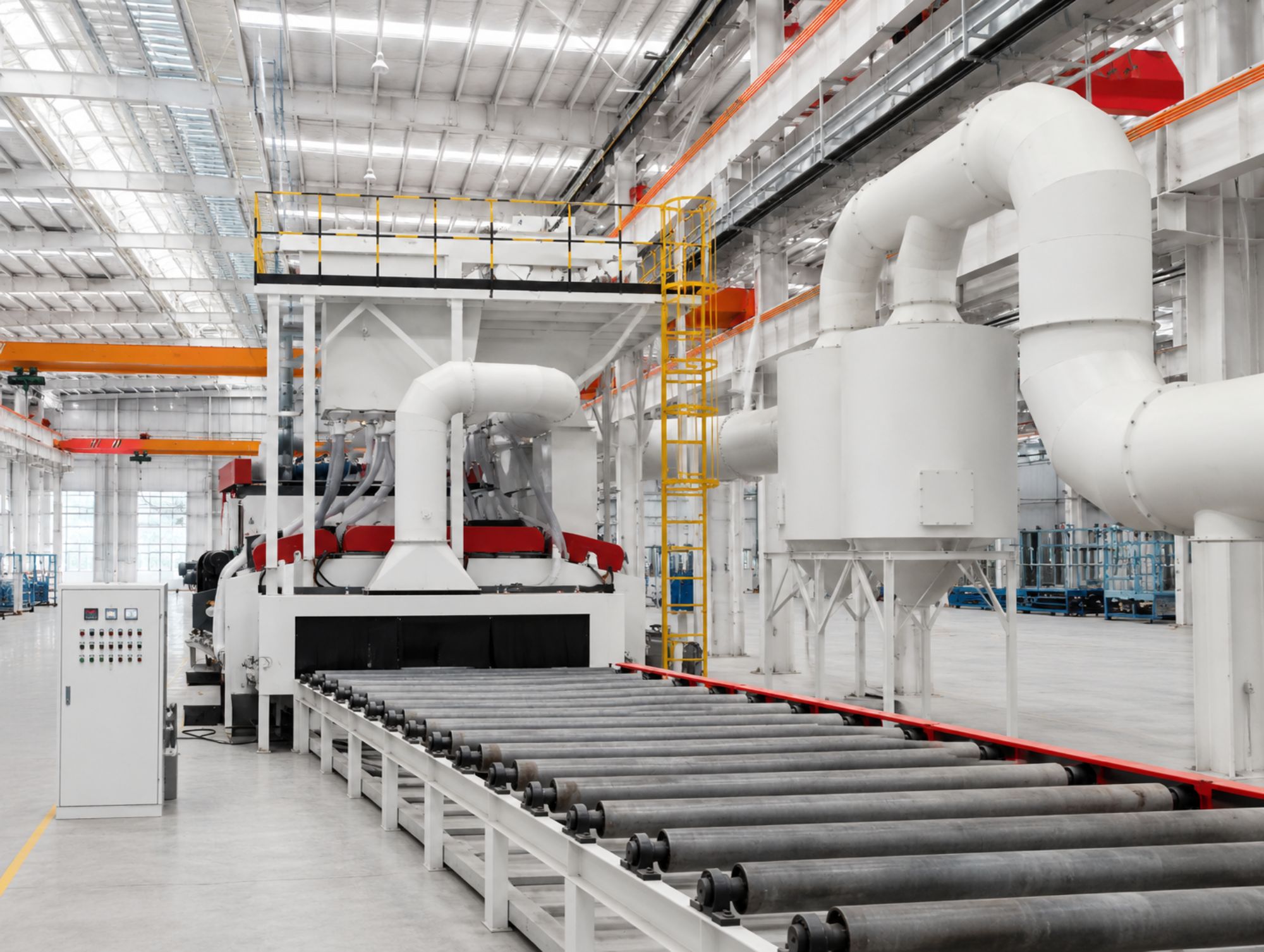
Standard blast machines are built around a simple assumption: the part surface is relatively flat, smooth, and uniform enough for abrasive media to hit it evenly. That works fine for basic plates or simple brackets. But when a component has deep recesses, threaded holes, sharp internal corners, or blind cavities, the same machine struggles. The media stream loses energy before it reaches those hidden areas, leaving behind uneven texture, residual scale, or corrosion in exactly the places that matter most for fatigue life or coating adhesion.
Complex parts also demand variable angles of impingement. A fixed nozzle array can only cover a narrow range of attack angles, and rotating the part on a simple turntable rarely compensates for undercuts or overlapping geometries. Operators end up manually re-blasting the same part, which slows down production and introduces inconsistencies. The result is a surface that might look acceptable at a glance but fails under real-world stress because critical zones never received the required impact energy.
Beyond geometry, standard machines lack the feedback needed to adjust in real time. Media flow, pressure, and standoff distance remain static even as the part profile changes. For a complex casting or welded assembly, that means some areas get over-blasted while others are barely touched. Without closed-loop monitoring or programmable motion for each workpiece, the operator is forced to rely on visual checks and guesswork, which is neither repeatable nor scalable for precision manufacturing.
Inside a Custom Build: Matching Abrasive Power to Substrate
Getting the abrasive power right on a custom build isn't a one-size-fits-all decision. The substrate's hardness, density, and even its thermal conductivity dictate how much aggressiveness the setup can take before things go sideways. A dense hardwood like hickory can handle a more forceful grit and a higher removal rate, while a soft pine or a thin-gauge metal panel will show every overzealous pass as burn marks, warping, or deep scratches that are hard to undo.
A practical approach is to start with the least aggressive combination that still bites into the surface, then ramp up only if the material isn't responding. Pay attention to how the abrasive loads up—if it's clogging quickly on a soft substrate, dropping the power and switching to a stearated or open-coat abrasive can keep the cut clean without generating excess heat. On harder substrates, a clogged abrasive usually means the power is too low, so the grains are polishing instead of cutting.
The operator's feel matters just as much as the specs. Watch the dust, listen to the motor, and touch the workpiece between passes. If the surface is too hot to hold your hand on, the abrasive is doing more damage than good. Small test patches on an offcut or an inconspicuous area will tell you more about the right match than any chart—because every custom build brings its own quirks to the bench.
Surface Prep That Keeps Pace With High-Volume Coating Lines
When a line runs at 20 or 30 metres per minute, every second spent on poor surface preparation turns into rework downstream. The real bottleneck is rarely the blasting cabinet or wash stage itself—it's the transition between cleaning, drying, and coating. Keeping pace means sizing air knives, nozzle banks, and dry-off ovens to match peak line speed, not average throughput. It also means choosing media that breaks down slowly enough to avoid constant topping up, yet still leaves a profile that grabs the coating without over-roughening thin substrates.
High-volume lines demand more than raw speed; they need repeatability across thousands of parts per shift. Automated blow-off stations with adjustable air pressure and angle, combined with demineralised water rinses, cut down on residual dust and water spotting that cause adhesion failures. Inline surface inspection—simple camera checks for dry film thickness or residual salts—gives operators a chance to correct drift before a full coil or batch is coated. Small footprint designs, like vertical or U-shaped wash tunnels, free up floor space while maintaining dwell time.
Finally, surface prep should not fight the coating chemistry. A conversion coating that suits one powder line may slow down a liquid line if it leaves too much soluble salt. Matching the prep chemistry to the specific coating and substrate—and verifying it with a quick tape or cross-hatch test at line start—prevents the kind of sporadic adhesion loss that only shows up after the customer takes delivery. That is how surface prep keeps pace: not as a standalone step, but as an integrated part of the line's cadence.
Avoiding Bottlenecks With Continuous Flow and Variable Speed
Most production slowdowns don't come from a single failing machine—they creep in when materials pile up at one station while another sits idle. Shifting to continuous flow means rethinking the entire process as a single moving line instead of isolated batches. You stop treating each step as its own storage point and start syncing output rates so work glides from one stage to the next without waiting. At first glance that sounds fragile, but with variable speed drives on pumps, conveyors, and mixers, you can fine-tune every motor to match the real-time demand of the next operation downstream.
A common mistake is setting every motor to full speed and hoping surplus capacity absorbs delays. That actually creates bottlenecks because upstream equipment floods the next stage before it can process what's already there. Instead, use sensors or simple operator feedback to trim speed on the feeding side when downstream buffers are nearly full. When a downstream station clears, the upstream motors ramp back up. This dynamic adjustment keeps material moving in a steady stream rather than surging and stalling. The result is less inventory sitting in queues, shorter lead times, and fewer incidents of equipment running empty while waiting for the previous step to catch up.
Getting the speed relationships right takes some trial and error, especially when product changeovers alter the ideal flow rate. Start by mapping the bottleneck operation—usually the slowest or most variable step—and then set that as the master speed reference. Slave the upstream and downstream equipment to that reference with proportional offsets. With variable speed control, you can store different profiles for each product family, so changeovers become a matter of recalling a setpoint rather than physically swapping pulleys or gears. Over time, the line learns to breathe with the actual work content of each order, avoiding the stop-start rhythm that quietly eats away throughput.
From Blueprint to Installation: What to Expect From a Specialty Builder
A specialty builder starts by sitting down with your plans, not just to quote a price but to understand how you intend to use the space. They will walk through the blueprint room by room, flagging areas where standard materials might fail under your specific conditions—think humidity control for a wine cellar, load-bearing walls for a workshop, or sound isolation for a home theater. This is also the moment when rough sketches become a realistic build schedule; you should expect honest feedback about what can be done within your timeline and where the design may need small adjustments before anything is ordered.
Once the drawings are finalized, the builder moves into pre-construction. This phase often reveals the difference between a general contractor and a true specialist. They will submit permit applications, coordinate structural engineering reviews, and source materials from suppliers who deal in the specific products your project demands—not whatever is left in a big-box warehouse. You might receive a detailed procurement list with lead times for custom steel brackets, acoustic panels, or climate-control units, and those lead times will drive the installation date more than any optimistic guess.
During installation, the specialty builder manages the sequence carefully. They will not frame walls before the plumbing rough-in if the design calls for hidden tank systems, and they will not hang drywall until every conduit and sensor wire has been tested. Expect regular walkthroughs at critical milestones—after framing, after mechanical systems, after finishes—so you can see how the blueprint is translating into built form. The final handover includes more than keys; you get a folder with as-built drawings, maintenance schedules for specialty equipment, and contact information for the exact crew that did the work, not a generic service line.
FAQ
A custom machine is built around your specific part dimensions, throughput targets, and surface finish requirements. Instead of forcing your components into a one-size-fits-all chamber, the manufacturer adjusts blast wheel placement, conveyor speed, abrasive type, and even the number of cleaning stations to match your production line. This leads to more consistent coverage, lower abrasive waste, and fewer manual touch-ups.
Heavy fabrication, automotive, foundry, aerospace, and structural steel operations see the biggest gains. Any shop processing beams, plates, castings, forgings, or welded assemblies in high volumes can justify a custom roller conveyor system because the parts move continuously and the blast pattern can be tuned for corners, edges, and recessed areas.
It starts with your part profile. The manufacturer studies the maximum width, height, and weight of the components, plus the desired cleaning speed. They then position blast wheels at strategic angles—typically top, bottom, and side—to avoid shadowing. Computer simulations and prior project data help balance abrasive flow so every square inch gets hit without overblasting thin sections.
Roller conveyor systems handle long, heavy, or flat parts that cannot be tumbled without damage. They also integrate easily into an existing production line, allowing continuous flow rather than batch processing. Compared to hanger machines, they often provide better bottom-surface cleaning and support for parts with uneven weight distribution.
Yes, many manufacturers build multi-stage roller conveyor lines that combine shot blasting, dust removal, and sometimes a primer or preservation coat. After the blast chamber, an air blow-off section removes residual abrasive, and an optional painting booth or drying tunnel can follow. This reduces handling between processes and lowers the risk of contamination before coating.
Chamber size, number and power of blast wheels, abrasive recycling capacity, dust collector rating, and automation level are the big drivers. A simple machine for small steel profiles costs far less than a wide, heavy-duty system with automated loading, part recognition, and multi-angle blasting. Customization itself doesn't always mean higher cost—it can eliminate unnecessary features and focus budget where it matters.
Top and bottom blast wheels are positioned at overlapping angles, and the roller gaps are calculated so abrasive can reach the underside without deflecting the part. Some machines also use adjustable roller spacing or rotating work supports. Regular monitoring of abrasive size, wheel speed, and conveyor velocity keeps the finish uniform across the entire width.
Daily checks include abrasive level and contamination, wear plate condition, and dust collector pressure. Weekly tasks cover wheel blade replacement, roller bearing lubrication, and seal inspection. Because each machine is tailored, the manufacturer provides a specific maintenance schedule tied to your operating hours and abrasive type—this helps prevent unexpected downtime and keeps blast performance stable.
Conclusion
A roller conveyor shot blasting machine only earns its place on the floor when it is built around the actual parts coming down the line. Generic systems tend to struggle with complex profiles, deep pockets, or mixed alloys, leaving uneven profiles or forcing operators to slow the pace. By working with a manufacturer that builds from your drawings, abrasive choice, wheel position, and conveyor speed are matched to the substrate rather than guessed. That means thin sections stay intact, stubborn mill scale comes off, and the anchor pattern is uniform enough for coating adhesion without rework.
The real difference shows up in high-volume coating lines, where a stop-and-start blast cabinet quickly becomes the bottleneck. A tailored roller conveyor setup runs continuously and lets you fine-tune belt speed to match upstream cutting and downstream painting, so parts flow through cleaning instead of stacking up. From the first layout review to final commissioning, the builder should handle nozzle angles, dust extraction, and wear zones as part of one system. The result is not a catalog machine with extra options bolted on, but a surface preparation step that fits the production rhythm and holds that rhythm shift after shift.
Contact Us
Contact Person: Bruce
Email: [email protected]
Tel/WhatsApp: +86 15166629468
Website: https://www.povalchina.com/