

High-Quality Puff Snack Food Production Line for Consistent Texture and Flavor
2026-09-09
Picture this: a puff snack that shatters with the same delicate crispness in every single bite, batch after batch. That level of consistency doesn’t happen by accident—it’s engineered. In this post, we’re pulling back the curtain on the production line technology that locks in uniform texture and flavor, and why operators who refuse to compromise keep turning to MINGDE for the machinery that makes it possible.
Extrusion Pressure Curves That Shape Air Pockets
The pressure profile inside an extrusion barrel rarely gets the attention it deserves, but it is the hidden hand that controls how air pockets form and deform. Near the feed throat, pressure builds unevenly as granules compact, trapping pockets of air between them. As the melt moves forward, the rising pressure curve squeezes those trapped volumes into smaller, more elongated shapes. A sharp pressure spike just before the breaker plate can force air into solution or split larger voids into micro-bubbles, while a gentle, sustained plateau allows them to coalesce into rounder, more stable pockets.
Downstream of the screw tip, the pressure curve takes a different turn, and this is where the real shaping happens. The transition from high backpressure to atmospheric or vacuum conditions inside the die creates a steep gradient. Air pockets caught in this gradient stretch along the flow direction, their walls thinning under extensional stress. If the pressure release is too sudden, the pocket can collapse into a jagged cavity or burst through the melt surface. A controlled, tapered drop in pressure, on the other hand, yields smooth, lens-shaped air pockets that align neatly with the extrudate's axis.
Adjusting the pressure curve is not just about removing air; it is about giving the remaining pockets a predictable geometry. For example, raising the melt pump pressure while keeping the die temperature slightly lower changes the viscosity contrast at the pocket boundary, pulling the air pocket into a longer, thinner thread. Conversely, a flatter pressure curve near the die exit encourages spherical voids that act as intentional lightweighting features. Small changes in screw speed, backpressure valve settings, or die land length redraw the curve enough to shift the balance between trapped air, dissolved gas, and engineered void shapes.
Seasoning Drums That Coat Without Crushing
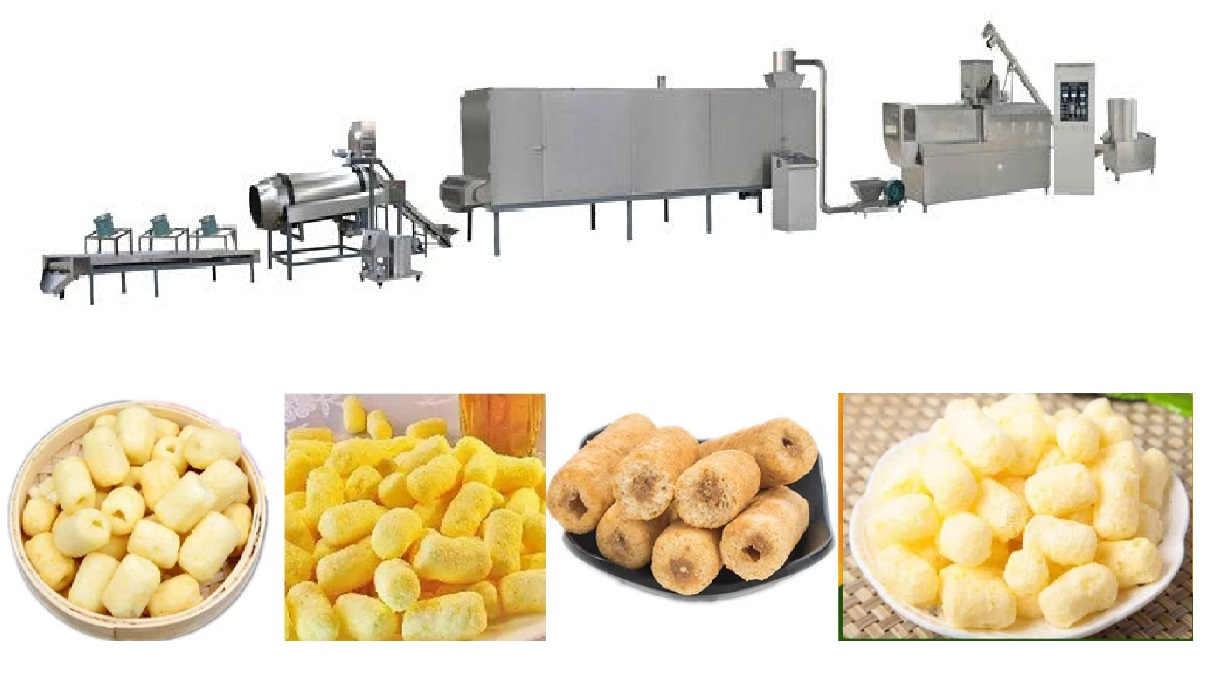
Achieving an even seasoning layer on delicate products comes down to controlling the tumbling motion. These drums use shallow flights and a low-shear rotation pattern that gently rolls and cascades the product instead of dropping it from high angles. Because the snack pieces spend more time suspended in a soft curtain, the seasoning dust has repeated contact with every surface, building a consistent coat while the structure stays intact.
The same principle applies across a wide range of fragile items, from ridged chips to baked crackers and puffed snacks. Operators can fine-tune drum speed, tilt, and internal baffle placement to match the breakage threshold of each product. In many setups, a light mist of oil or binder is applied just before the seasoning enters the drum, helping the powder adhere without relying on aggressive tumbling or excess coating that would otherwise build up in pockets.
Moisture Removal That Keeps the Crunch Alive
Achieving a satisfying crunch isn’t just about frying or baking at the right temperature—it’s also about what happens to the water inside the food after it leaves the heat. Pull out too much moisture and you end up with something brittle and dusty; leave too much behind and the structure softens within minutes. The real trick is removing water in a way that preserves the delicate air pockets and starches responsible for that snap.
Instead of blasting the product with hot, dry air until every last drop is gone, modern methods use a gentler pull. Low-humidity environments combined with carefully timed airflow draw moisture away from the surface without collapsing the internal matrix. Some packaging even includes food-safe desiccants that keep absorbing stray humidity after sealing, so the crunch doesn't fade on the shelf.
You can taste the difference in a chip that still shatters between your teeth a week after opening, or a cookie that retains its crisp edge while the center stays just tender enough. That balance comes from moisture removal that works with the food’s natural texture, not against it. It’s less about drying and more about guarding the architecture of crunch.
Managing Oven Airflow for Even Browning
Oven hot spots are rarely random. They usually trace back to how air moves through the cavity. A tray placed too close to the back wall can block return vents, while a large roasting pan directly under the upper element can deflect hot air unevenly. Before adjusting temperature or time, take a quick look at what might be interrupting the natural circulation. Sometimes shifting a rack up or down one notch does more for browning than adding another ten minutes.
If you use convection, remember that the fan is not a guarantee of even color. It amplifies whatever airflow pattern already exists. For cookies, pastries, or anything with delicate surfaces, try leaving at least an inch between pans and the oven walls. When baking on two racks, stagger them so one isn’t directly above the other, and rotate front to back halfway through. This small move prevents the lower tray from steaming the upper one and lets dry, hot air reach every exposed edge.
For foods that need deep, uniform color—like roasted vegetables or bread with a thick crust—consider preheating longer than the beep suggests. A fully heated oven wall radiates more consistently and reduces the chance of pale centers. If you notice one side darkening faster, don’t keep opening the door to check; each opening drops the temperature and disrupts airflow. Instead, use the oven light and make one decisive rotation at the halfway point. That restraint often makes the difference between patchy and polished browning.
Cutting Blades That Don't Compromise Structure
Many cutting blades are thin enough to slice but flex under load, drifting off-line and tearing the material instead of separating it cleanly. These blades use a stepped thickness profile that shifts mass away from the edge, keeping the spine rigid where it matters. The result is a cut that follows the intended path without crushing the surrounding layers.
Heat buildup is usually the hidden enemy of structure retention. Instead of relying on coatings that wear away, the steel is chosen for its high thermal diffusivity, pulling heat out of the edge quickly. That prevents localized softening, so even dense or abrasive materials can be processed repeatedly without edge deformation.
The mounting interface also avoids stress risers common in stamped blades. A gradual transition from clamp area to cutting zone distributes bending forces, so the blade stays flat against the anvil or bed. That flatness is what keeps cuts perpendicular and prevents the wedge effect that splits fibrous or layered structures apart.
Recipe Management for Repeatable Texture and Taste
Nailing the same mouthfeel and flavor every single time rarely happens by accident. It comes from treating your recipe as a living document, not a rough sketch. That means recording everything that could possibly shift the outcome: the exact brand of flour, the precise temperature of your liquids, how long you rest the dough, even the humidity in your kitchen on a given day. When you log these details consistently, you start to see patterns — and you stop wondering why batch three turned out denser than batch one.
A repeatable recipe also has built-in checkpoints. Instead of just writing “bake until golden,” you note the internal temperature, the spring-back feel, and the sound the crust makes when tapped. These sensory and measurable cues act as guardrails, so you don't rely on guesswork when your oven or ingredients shift slightly. Over time, you build a personal library of tweaks: a pinch more salt for a different butter, a few extra grams of water on dry winter days. That flexibility is what keeps the end result consistent even when conditions don't cooperate.
Finally, treat every batch as feedback. Jot down what worked, what felt off, and any small change you made on the fly. This turns your recipe into a tool for decision-making rather than a static list of steps. The goal isn't to freeze a single perfect version — it's to understand the levers that control texture and taste so you can pull them with confidence, every time you step into the kitchen.
FAQ
It combines precision extrusion with closed-loop temperature control. The screw profile and die geometry are tuned for the specific starch matrix, and sensors adjust heating zones in real time so each piece leaves the die at the same expansion point.
It works with corn, rice, wheat, potato, and multi-grain blends. Changing recipes mostly means swapping the preconditioner settings and die insert, not re-engineering the line.
Flavor is applied in a rotating drum after drying. The drum uses programmable spray nozzles and a tumbling speed matched to the snack’s shape, so seasoning clings evenly without crushing delicate puffs.
Depending on configuration, you can run from roughly 150 kg/hr up to 500 kg/hr of finished product. Throughput is adjusted by screw speed and cutter RPM, not by sacrificing puff quality.
It is fully continuous from preconditioning through drying and coating. The only scheduled pauses are for cleaning and die changes, which are designed to be quick-release.
The extruder’s barrel and die temperatures are held within a narrow band, and the moisture preconditioning step stabilizes the melt. A rapid pressure drop at the die face creates the expansion, while a post-extrusion dryer locks the structure before oil or seasoning is added.
A typical layout runs about 25–40 meters in length depending on dryer length and whether you use a single or double coating drum. It can be arranged in an L-shape to fit existing plants.
Conclusion
Achieving a consistent, high-quality puff snack demands more than just mixing and baking. The extrusion stage relies on carefully tuned pressure curves that create uniform air pockets, giving each piece its signature lightness. Without this precision, texture varies from batch to batch. Once formed, the snacks pass through seasoning drums engineered to coat every surface evenly without crushing the delicate structure—a common failure point in lesser lines.
Moisture control is equally critical: targeted drying preserves the crunch that defines the product, while oven airflow is managed to ensure even browning without hot spots. Cutting blades are designed to slice cleanly, leaving edges intact and preventing collapse. Behind all of this, recipe management systems lock in exact parameters for repeatable taste and texture, so every run matches the last. Together, these elements form a production line where each step safeguards the final mouthfeel and flavor profile.
Contact Us
Contact Person: LILY SUN
Email: [email protected]
Tel/WhatsApp: 0086-13969103791
Website: https://www.snackfoodmachinery.com/