

High Speed Door Factory: Essential Guide for Industrial Buyers
2026-09-07
Industrial buyers often face a maze of options when searching for a high speed door factory. You need more than just a supplier—you need a partner that understands logistics, safety, and uptime. That's where NORTON comes in. In this guide, we'll cut through the noise and show you exactly what to look for in a factory, so you can make a confident decision without the usual trial and error.
Decoding Door Speed Ratings for Real Production Floors
Manufacturers love quoting peak door speeds, but those numbers rarely reflect what happens once a door is mounted between a busy production area and a loading dock. The rating usually comes from a controlled test with no wind load, no pressure differential, and a perfectly aligned track. On a real floor, forklift traffic, thermal currents, and worn guides shave seconds off the opening cycle, so the "fast" door on paper often moves noticeably slower when it matters most.
A more useful way to read the specs is to ignore the single headline figure and look at full cycle time—how long from first activation to a clear, safe opening, and then back to a sealed close. Some doors open aggressively fast but crawl on the closing stroke to avoid impact, which can trap heat or let conditioned air escape longer than expected. In food or pharma environments, that slow close can be a bigger problem than a slow open.
Field conditions also change the math. A 10-foot door in a cold storage wall sees a constant push of dense air, while the same model on an interior partition barely notices a pressure drop. If the rating doesn't specify wind load class or cycles per day at a given speed, treat it as a starting point, not a promise. The best approach is to ask for a demo under your actual air balance and traffic pattern, then measure the cycle time yourself.
Fabric Choices That Survive Forklift Grazes and Temperature Swings
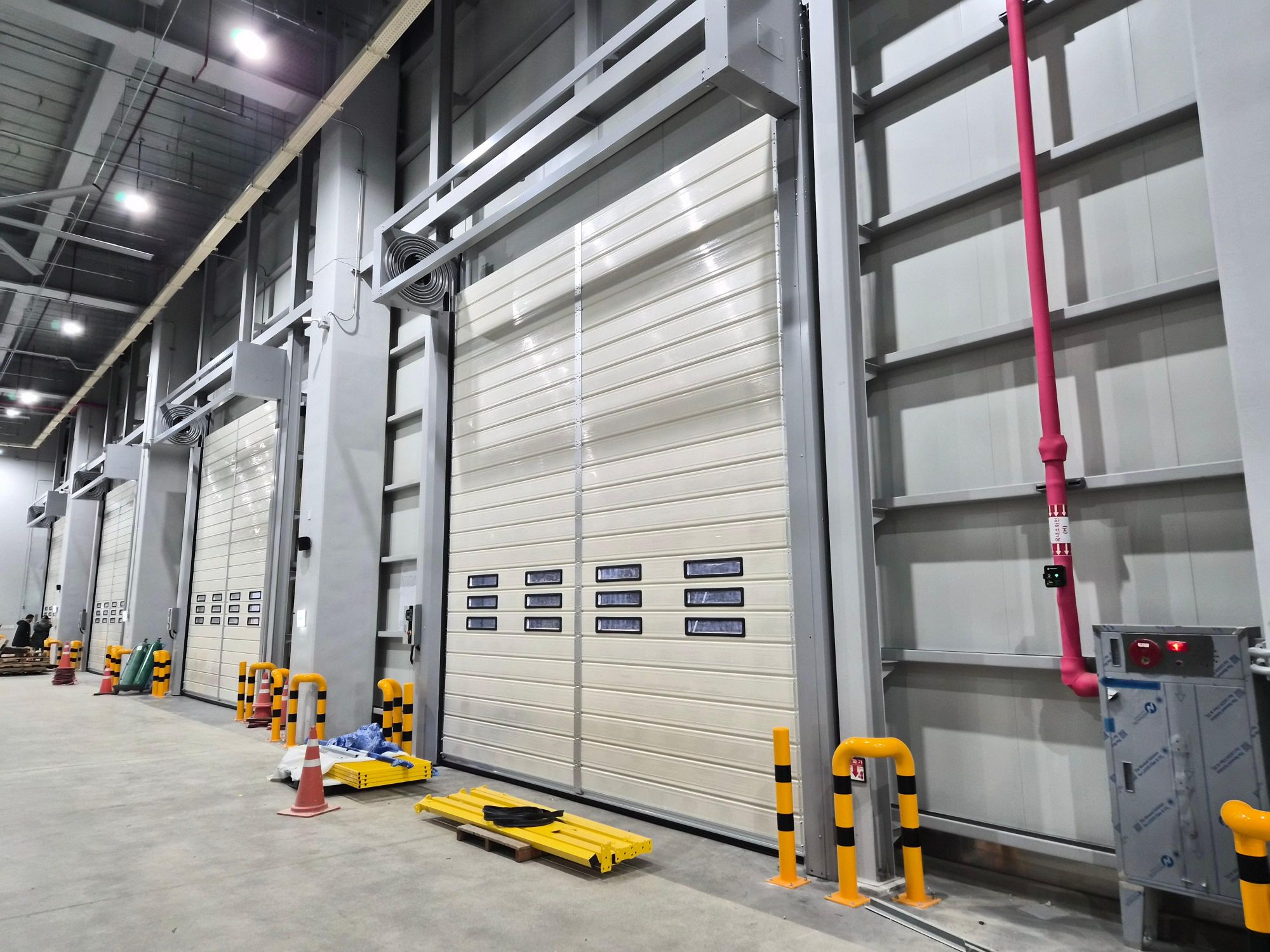
Finding a fabric that can handle both the abrasive scrape of a forklift tine and the sudden chill of a loading dock in winter isn't just about picking something tough — it's about understanding how materials fail. Most standard canvases or coated nylons will tear within months under repeated side-swipes, while cheaper polyesters stiffen and crack when temperatures drop below freezing. The real workhorses are dense, high-tenacity woven synthetics with a low-friction face, because they let the forklift glance off instead of digging in.
For doors, curtains, and protective sleeves in warehouses or cold-storage facilities, start with a PVC-coated polyester that has a minimum 18-ounce base weight. The PVC layer handles the temperature swings without becoming brittle down to about -20°F, and the polyester scrim underneath resists punctures better than vinyl alone. If you need better cold performance, look for a polyurethane-coated nylon with a matte finish — it's less likely to stick to metal during rapid temperature shifts and offers a smoother glide surface. Avoid any fabric that relies on a soft acrylic topcoat; those start to flake after the first hundred grazes and leave behind dusty residue that contaminates inventory.
One underrated option is a woven fiberglass fabric with a silicone coating. It's heavier than the synthetics and costs more upfront, but it shrugs off both abrasion and extreme temperature swings (from -65°F to 500°F) without losing flexibility. The silicone gives it a slightly tacky surface that actually helps it grip onto door frames rather than flapping loose, and a quick scrape from a forklift usually just leaves a cosmetic mark instead of a tear. The main downside is weight, so reserve it for high-traffic openings where replacement downtime is more expensive than the material itself.
Safety Systems Built Into Modern Rapid Doors
Modern rapid doors are no longer just about speed and convenience—they now carry a full suite of safety mechanisms that work quietly behind the scenes. From the moment a forklift approaches, sensors embedded in the door frame detect motion and trigger an immediate stop or reversal before contact can occur. Light curtains, pressure-sensitive bottom edges, and radar-based presence detectors all contribute to a layered defense that keeps both workers and equipment out of harm’s way, even in high-traffic loading docks or cold storage areas.
Beyond basic obstruction sensing, many advanced rapid doors include programmable logic that adapts to the specific rhythm of a facility. For instance, a door might pause at a partially open height to allow pedestrian passage while blocking larger vehicles, or automatically close after a set interval to maintain temperature control without trapping anyone inside. Emergency stop buttons, manual release mechanisms, and battery backup systems ensure that even during power failures or system faults, the door remains safe to operate and easy to open by hand.
What sets today’s designs apart is how these safety features are integrated rather than bolted on. Manufacturers embed wiring, sensors, and controllers into the side guides and bottom bar, eliminating exposed cables and pinch points. Self-monitoring routines run daily checks on each sensor’s response time and signal strength, flagging any drift long before it becomes a hazard. This combination of real-time detection, graceful failure modes, and continuous self-diagnostics makes modern rapid doors a reliable partner in protecting both people and productivity.
Getting the Opening Dimensions and Clearances Right
Measure the rough opening at three points horizontally and vertically instead of trusting a single width or height. Older framing rarely stays perfectly square, and the smallest of those numbers is the one that governs whether the unit will slide in without forcing it. Check the diagonals as well; a difference beyond 1/4 inch usually means the opening is racked and will need correction before you proceed.
Leave enough room for shims and hardware, not just the nominal unit size. A gap that is too tight makes adjustment impossible, while too much space creates weak points around the fasteners. On most door and window replacements, keeping the rough opening 1/2 to 3/4 inch wider and about 1/2 inch taller than the outside frame gives you room to level, plumb, and square everything without overloading the shims.
Before any final trim or caulking, open and close the moving panel several times and watch the reveal around the edges. If the gap changes noticeably through the swing or slide, the frame is flexing or the hinges are binding, and that usually traces back to the opening being out of plane. Fix those clearance issues while the opening is still exposed; trim will hide small variations but it will not correct a misaligned frame.
Service Schedules That Keep Downtime From Eroding Profits
Downtime rarely announces itself politely. It tends to arrive during peak production windows, turning a routine shift into a scramble for spare parts and emergency callouts. A well-structured service schedule flips that script. Instead of reacting to failures, the schedule treats maintenance as a non-negotiable operating rhythm, much like payroll or safety checks. By aligning service intervals with actual equipment wear patterns rather than generic calendar dates, you cut the hidden costs that accumulate when a line sits idle: missed deliveries, overtime labor, rushed freight, and the slow erosion of customer trust.
The real leverage comes from sequencing. Not every asset deserves the same level of attention. High-cycling machines near the end of their service life need shorter intervals, while auxiliary equipment can run longer between checks. A tiered schedule that ranks assets by consequence—what happens if this fails, and how fast can we recover—allows maintenance teams to concentrate effort where downtime would hurt the most. Pair that with condition-based triggers, like vibration thresholds or thermal readings, and you avoid both premature part replacements and catastrophic surprises.
Flexibility matters more than perfection. A rigid schedule that ignores shifting production demands or supply delays quickly becomes a paperwork exercise. The most profitable service programs build in buffer windows, cross-train technicians so one absence doesn't stall the entire plan, and review schedule performance every quarter against actual failure data. When the schedule adapts to reality instead of chasing an abstract ideal, uptime stops being a hope and becomes a measurable output—one that shows up directly on the bottom line.
Smart Controls and Integration With Existing Line Logic
Modern smart controls don't replace existing line logic; they sit on top of it, reading discrete I/O states and register values that the PLC already manages. By mapping physical sensors, actuators, and interlock signals into a digital twin or edge gateway, operators gain real-time visibility without rewriting the core ladder diagram. This preserves the validation work already done on the line while adding a layer of adaptive decision-making.
Integration typically starts with protocol bridging—Modbus TCP, EtherNet/IP, or OPC UA—so that smart algorithms can query cycle times, fault codes, and part counts from legacy controllers. Instead of forcing a rip-and-replace, the control layer watches for subtle drift: a pneumatic cylinder that takes 200 milliseconds longer to extend, a conveyor motor drawing 8% more current, or a reject station triggering twice as often as the baseline. When these patterns cross thresholds, the system can recommend or implement small adjustments, such as tweaking a timer preset or shifting a reject window, while the original safety interlocks remain untouched.
The result is a line that behaves less like a fixed sequence and more like a self-tuning system. Operators still see familiar HMI screens, but now those screens include contextual hints—like "increase palletizer wait time by 0.3s to reduce jam at merge point"—based on actual upstream and downstream conditions. Because the smart layer only writes to non-safety registers and always respects the existing mode selection and e-stop logic, integration stays reversible and low-risk.
FAQ
The difference often shows up in the details. A strong factory will have an in-house engineering team that can modify door designs for unusual openings, not just assemble standard panels. They'll also be transparent about their cycle testing and can provide references from facilities with similar operational demands. If they hesitate to share technical drawings or test data, that's a red flag.
Start with what actually moves through the opening. For food processing or pharmaceutical plants, cleanroom-rated rapid roll doors with stainless steel guides make sense. In logistics hubs with constant forklift traffic, reinforced fabric doors or rigid panel doors that resist impact are often the better call. Dirty or washdown areas need sealed guides and corrosion-resistant components. The factory should help you map traffic patterns, temperature differentials, and hygiene requirements before recommending a model.
Because real-world use is far harsher than a catalogue suggests. A factory that runs accelerated life tests—opening and closing doors hundreds of thousands of times under load—can tell you exactly when springs, motors, and fabric will need service. Without that data, you're buying on faith. Ask for test reports that show cycle counts, wind load resistance, and safety sensor response times.
Even the best door will eventually need attention, and downtime in a busy industrial facility is expensive. A trustworthy factory will offer installation supervision, scheduled maintenance programs, and guaranteed spare parts availability for many years. Ask how quickly they can ship a replacement panel or motor, and whether their technicians can troubleshoot remotely. Support quality often determines whether a door lasts eight years or fifteen.
Yes, and the savings can be substantial if the doors are properly specified. By opening and closing in seconds, they minimize air exchange between different temperature zones, reducing strain on HVAC systems. Insulated panels and airtight seals further cut thermal loss. One food processing plant we know cut its cold storage energy use by nearly a third after replacing old bi-fold doors with well-fitted rapid roll models.
Beyond basic dimensions and colors, look for control system flexibility. The door should integrate with existing warehouse management or building automation systems. Good factories offer multiple activation methods—radar, induction loops, push buttons, remote controls—and can add vision panels, warning lights, or special fabrics for chemical resistance. If they can't adjust the door's opening speed or safety sensor logic to suit your workflow, keep looking.
Typical lead times run four to eight weeks for standard high speed doors, depending on factory backlog and shipping distance. Heavily customized doors might take ten to twelve weeks. Avoid factories that promise significantly faster delivery unless they carry pre-assembled stock, because rushed production often skips quality checks. Always confirm whether the lead time includes on-site installation or just delivery to your dock.
Conclusion
A door's published speed rating rarely matches what happens on a real production floor. Lab numbers assume clean tracks, mild temperatures, and no wind load; buyers should ask for cycle times under their own operating pressures and dust levels. Fabric choice matters just as much as the motor. A standard PVC curtain may survive occasional forklift grazes, but repeated impacts call for reinforced webbing or self-repairing materials, while freezer or oven-adjacent openings need insulated or heat-resistant panels that will not stiffen or crack. Modern rapid doors also carry safety systems that go beyond a simple photo eye—pressure-sensitive bottom edges, breakaway guides, and motion sensors can stop a closing panel before it hits a person or pallet. None of that helps if the opening dimensions are wrong. Before ordering, measure true side room, headroom, and floor slope; a door that fits on paper may bind against a tilted guide or an overhead beam once installed.
Service schedules are where profit either holds or quietly erodes. A high speed door factory that stocks common wear parts and publishes a clear maintenance routine—monthly tension checks, quarterly drive inspections, and annual safety-edge verification—gives you a realistic way to prevent a jammed curtain from blocking a shift. Smart controls and integration with existing line logic turn the door from an isolated barrier into part of the production sequence. Look for interfaces that accept PLC signals, AGV triggers, or barcode scanner outputs; a door that opens only when a load is actually approaching saves energy and reduces unnecessary cycles. Choose a supplier that documents its wiring and control protocol before the order ships, because retrofitting an extra sensor or changing a timer later costs more than specifying it from day one. The best factory pairs heavy-duty hardware with local service support and honest engineering guidance, so the door runs as part of your cell instead of against it.
Contact Us
Contact Person: Cyril He
Email: [email protected]
Tel/WhatsApp: 8613969697307
Website: https://cqyqgd.en.alibaba.com/