

Reliable Water Pump Generator Set Supplier for Efficient Water Pumping Solutions
2026-05-27
When it comes to efficient water pumping solutions, reliability isn’t just a feature—it’s the backbone of every operation. Whether you’re managing irrigation systems, industrial processes, or emergency dewatering, the right generator set can make all the difference. At Hichai Power, we’ve built our reputation on delivering robust pump generator sets that keep water moving when it matters most. But what truly sets a trusted supplier apart in a sea of options? Join us as we dive into the essentials of choosing a partner that combines performance, durability, and real-world expertise.
How Our Generator Sets Keep Water Flowing, No Matter What
Water supply systems live and die by steady power. When storms roll in or a transformer blows, the sudden silence of a treatment plant or pump station can mean taps running dry within hours. Our generator sets are hardwired to detect those grid failures instantly, firing up in under ten seconds to maintain flow. They don't just bridge the gap—they keep pressure stable so that backflow doesn't contaminate the entire line, a detail many overlook until it's too late.
Field crews will tell you the real test isn't the first hour, but day four of a widespread outage when fuel logistics get tricky. These units are designed with that in mind, sipping diesel conservatively during low-demand periods and ramping up as needed. Paired with remote monitoring, they flag maintenance needs before they become breakdowns. In remote well fields where the nearest technician is a two-hour drive away, that kind of self-reliance isn't just helpful—it's the only way to guarantee water keeps moving.
Engineered for Efficiency: Powering Pumps with Less Fuel
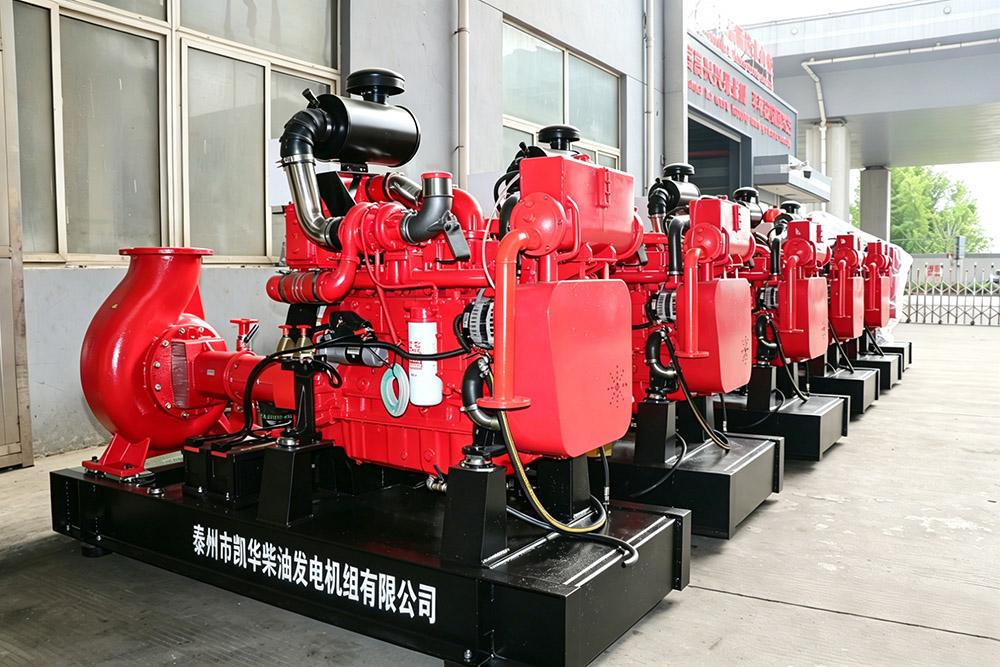
In an era where every drop of fuel counts, our pump systems are redefining what it means to work smarter. By integrating advanced hydraulic designs with precision-machined components, we've cut parasitic losses to a bare minimum. The result is a machine that delivers full-rated flow without guzzling fuel—keeping your operational costs low and your uptime high, even during marathon duty cycles.
The secret lies in the intelligent matching of engine load to pump demand. Rather than running wide open and wasting energy, our adaptive drive train senses real-time requirements and adjusts output accordingly. This closed-loop efficiency loop means you burn only the fuel you actually need—no more, no less. It's a pragmatic approach that translates directly into fewer refueling stops and a lighter logistical footprint for remote or large-scale projects.
We sweat the small stuff so you don't have to. From low-friction seals that reduce internal drag to optimized impeller geometries that move more water per revolution, every element has been scrutinized for fuel-saving potential. The payoff is clear: customers report double-digit percentage reductions in fuel consumption compared to conventional pumps, without compromising on throw distance or pressure. Efficiency isn't just a design goal—it's the whole point.
Built to Endure: The Reliability Behind Every Drop
True reliability isn’t a feature you add at the end—it’s a thread that runs through every material choice, every design decision, and every test cycle long before a single drop leaves the production line. We think of endurance as a quiet promise, kept over thousands of cycles in conditions most products never have to face. From the polymer seals that maintain their integrity after exposure to extreme temperature swings, to the micro‑polished channels that resist scaling even under mineral‑heavy loads, each component has been deliberately selected not just for what it does at the start, but for how it performs after years of silent, daily duty.
That’s why our validation labs don’t stop at industry baselines. We push prototypes through accelerated wear simulations that compress a decade of real‑world stress into a few relentless months. Leak tests don’t end at the first pass; they repeat after vibration, thermal shock, and chemical soak cycles that mimic everything from a coastal salt‑sprayed installation to an indoor high‑use commercial setting. The numbers that matter most aren’t the theoretical MTBF figures on a spec sheet—they’re the zero‑failure runs we demand before a design ever gets a nameplate.
Behind every drop that reaches you is a trail of discarded iterations, borderline results that we refused to accept, and assemblies that were retired early simply because they only met the standard instead of redefining it. That stubbornness is what turns a well‑made product into a genuinely dependable one. It means when you see water flowing at 3 a.m. in a building you’ve never visited, the component doing the work is the same one we tested to the point of boredom, because reliability isn’t about excitement—it’s about the moment nothing goes wrong, every single time.
From Farms to Flood Control: Versatile Pumping Solutions
A reliable water pump doesn't just move water—it adapts to the job at hand. On a farm, that might mean pulling from a shallow pond to irrigate a dry field or transferring liquid fertilizer without clogging. The same unit, with a quick adjustment or attachment swap, can tackle a flooded basement, redirecting murky water away from vulnerable structures. This kind of flexibility comes from smart engineering: wear-resistant impellers, multi-stage pressure options, and engines that sip fuel whether they're idling on standby or roaring at full throttle.
The real test happens when the skies open up and floodwaters rise. Municipal crews and emergency responders count on portable, high-capacity pumps to protect neighborhoods and business districts. The best designs strip away complexity—tool-free hose connections, rugged frames that survive a tumble off a flatbed, and oversized trash-handling capabilities that swallow debris without missing a beat. These aren't delicate instruments; they're workhorses built to start on the first pull after months of neglect.
What ties these scenarios together is a focus on user-level adaptability. A single pump platform can be outfitted with tractor PTO linkage for the back forty, then switched to a high-volume axial flow stage for flood duty. Contractors and growers alike appreciate the simplicity: fewer machines to maintain, familiar controls, and the confidence that comes when a tool performs just as well at half load as it does at peak demand. It's pumping centered on real-world patterns, not idealized specifications.
Smart Features That Simplify Your Pumping Operations
Modern pump systems come equipped with intuitive controls that take the guesswork out of daily operations. Adaptive speed drives, for example, automatically adjust motor performance based on real-time demand, reducing energy waste and wear. Touchscreen interfaces display vital metrics at a glance, while preset routines let you launch complex sequences with a single tap—no more manual tweaking at every shift change.
Predictive maintenance tools are another quiet workhorse. Embedded sensors monitor vibration, temperature, and pressure round the clock, flagging anomalies before they turn into costly downtime. Instead of rigid service calendars, you get smart alerts that tell you exactly when a component needs attention, keeping your team focused on production instead of firefighting.
Remote connectivity ties it all together. With secure cloud access, you can oversee pumping stations from anywhere—checking flow rates, adjusting setpoints, or even diagnosing issues from a tablet. It’s like having an expert operator on standby 24/7, without the extra headcount. These features don’t just simplify tasks; they reshape how teams interact with the equipment, making every action faster and more informed.
Why Settle for Standard? Custom-Tailored Power for Your Pumps
Off-the-shelf motors rarely fit the exact demands of critical pumping applications. A slight mismatch in torque curve, mounting dimensions, or thermal tolerance can lead to premature wear, unnecessary energy drain, or costly downtime. Custom-tailored power solutions bypass these compromises entirely. By engineering every winding, bearing selection, and cooling pathway to match your pump’s specific flow rate, pressure profile, and operating environment, you get a motor that runs cooler, lasts longer, and draws only the energy needed—no more, no less.
The real advantage surfaces under challenging conditions. Whether your pump handles abrasive slurries, high-temperature fluids, or strict hygiene requirements, standard motors often falter. Custom designs integrate upgraded sealing systems, non-corrosive housing materials, or advanced insulation to withstand these stressors. You aren’t just buying a motor; you’re gaining a power unit purpose-built to thrive in your exact scenario. This approach eliminates band-aid fixes like oversizing or external cooling jigs, simplifying installation and maintenance while boosting overall plant reliability.
Moreover, tailored power brings flexibility that off-the-shelf options can’t match. Need a vertical configuration with a thrust bearing designed for 24/7 lift station duty? Or a motor that starts smoothly under heavy inertia without tripping breakers? Custom engineering makes it possible without compromising efficiency or footprint. The result is a seamless integration into your system—mechanically, electrically, and thermally—delivering consistent performance year after year. When every pumping cycle matters, settling for a generic motor isn’t just a compromise; it’s a risk you don’t have to take.
FAQ
We provide a wide range of sets, including diesel, gasoline, and electric-driven models, suitable for everything from small-scale farm irrigation to heavy-duty industrial dewatering.
We use premium engines and pumps from trusted manufacturers, run each unit through rigorous performance tests before shipping, and include features like low-oil shutdown and overload protection.
Absolutely. Our engineers work with you to define flow rate, head pressure, and site conditions, then configure a set that perfectly fits without oversizing or wasting fuel.
We focus on smart sizing and high-efficiency impeller designs, plus diesel sets often include eco-mode throttling—this keeps fuel burn low while delivering the water output you need.
You’ll have access to remote troubleshooting, a dedicated spare parts channel, and optional on-site service contracts to keep downtime to a minimum.
Our equipment is commonly found in agriculture, construction, mining, municipal flood control, and anywhere reliable water movement is critical—we adapt the set to the job.
Conclusion
Water pump generator sets are the unseen backbone of countless operations, and ensuring an uninterrupted flow demands equipment that refuses to quit. Our approach centers on pairing robust engineering with relentless dependability, so whether a storm knocks out the grid or a remote farm needs irrigation around the clock, the pumps keep running. Every unit is fine-tuned to squeeze maximum output from every drop of fuel, trimming operational costs without sacrificing performance. Deep-drawn radiators, heavy-duty air filters, and reinforced frames allow these generators to shrug off dust, heat, and mud season after season. That kind of endurance means fewer interruptions, less maintenance, and more confidence when water simply cannot stop.
Versatility is just as critical. A fish farm, a construction dewatering site, and a flood-control station all place wildly different demands on a pump set, so our range spans from compact, trailer-mounted units to full-scale industrial powerhouses. Smart controllers take the guesswork out of daily operation—automatic start/stop, load sensing, and remote monitoring turn complex pumping networks into manageable systems. Yet the real difference is refusal to push a standard catalog solution when the situation calls for a tailored setup. Whether it’s a specific voltage, an extra-large fuel tank, or a sound-attenuated enclosure for a residential area, we build exactly what the job requires. That custom-fit philosophy turns a simple supplier relationship into a lasting partnership built on trust and precise performance.
Contact Us
Contact Person: Ms. Lu
Email: [email protected]
Tel/WhatsApp: 8618917899306
Website: https://www.hichaipower.com