

Turnkey Complete Cleanrooms Contractor: Your Partner for Precision-Controlled Environments
2026-09-13
In industries where a single airborne particle can compromise an entire batch, precision-controlled environments aren't a luxury—they're the backbone of compliance and product integrity. Yet building a cleanroom that meets strict ISO standards, stays on schedule, and adapts to your process is far from a plug-and-play task. That's where a true turnkey partner changes the game. GENO Pharmatech doesn't just hand over a set of drawings and wish you luck; we manage every phase—design, construction, validation, and beyond—so your facility is ready for operation from day one. What if your next cleanroom project could be streamlined, transparent, and tailored to your exact requirements without the usual coordination headaches? Keep reading to see how a complete cleanrooms contractor shifts the burden off your team and onto experts who live and breathe controlled environments.
One Contract, One Team, Zero Blame Games
A single contract does more than define scope and price. It sets the tone for how people work together. When everyone signs the same page, the usual finger-pointing loses its fuel. There is no room for “that wasn’t in my brief” or “the other vendor missed it.” Instead, the team starts asking a better question: what do we need to do right now to keep this moving?
Blame games often start when responsibilities are scattered across overlapping documents and hidden assumptions. One contract removes those gaps by making expectations explicit from day one. It pushes vendors, subcontractors, and internal teams to see themselves as a single delivery unit rather than separate parties protecting their own corners. That shift changes how problems are handled. A schedule slip becomes a shared issue to solve, not an opportunity to prove someone else failed.
The real value shows up when something goes wrong. In a blame culture, energy goes into building a defence. In a one-team setup, the same energy goes into finding a fix. Decision-making gets faster because nobody is waiting for a paper trail to justify their position. People speak openly about risks and mistakes because the contract has already done the hard work of aligning incentives. The result is a project where trust is not a slogan but a daily practice.
Cleanroom Performance Starts Long Before the First Panel Goes Up
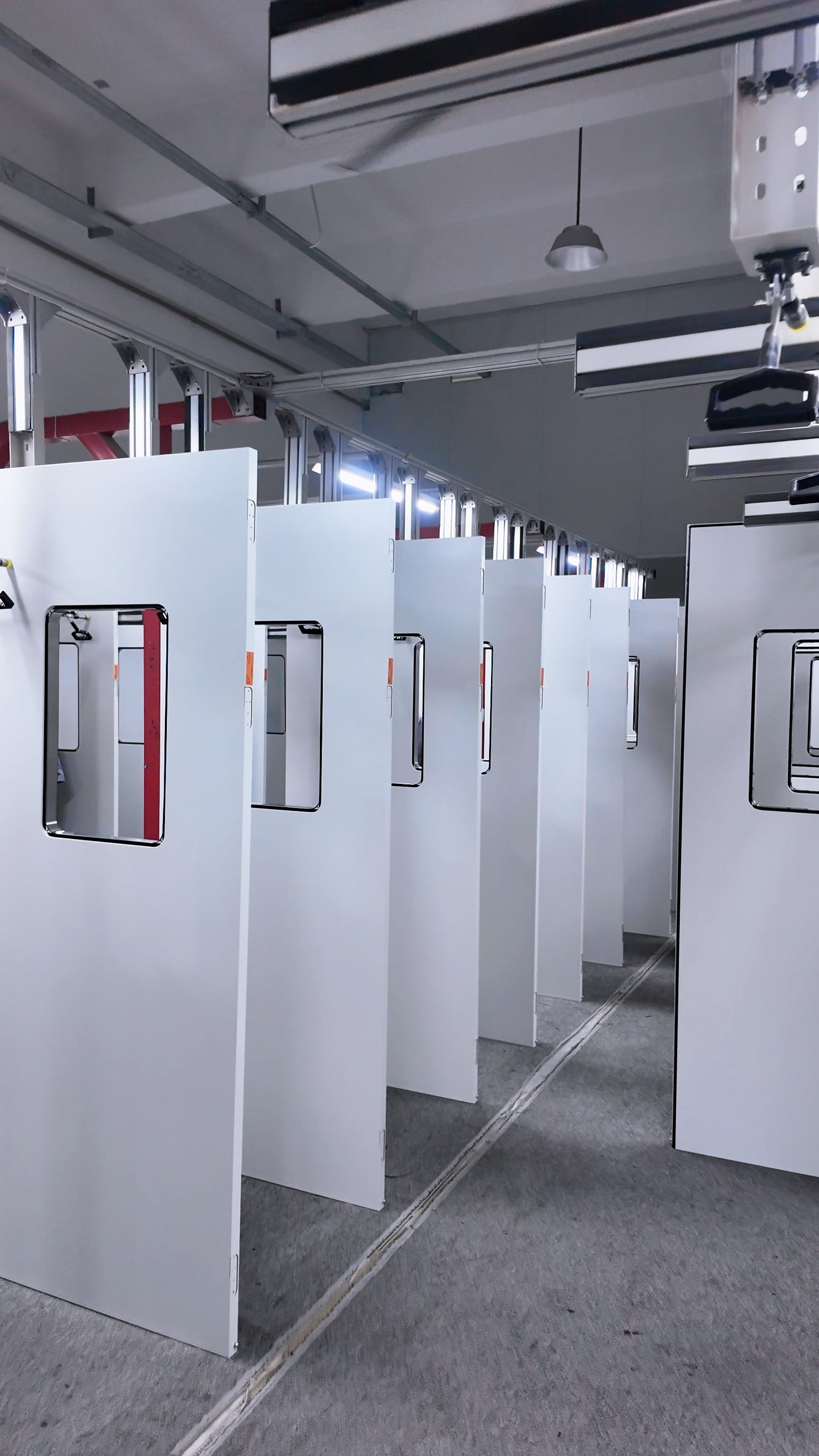
Long before the first cleanroom panel is lifted into place, the actual performance ceiling is already being set by decisions made on paper and in simulation. Airflow patterns, pressure cascades, and filter coverage don't improve once construction starts—they either work from day one or they don't. A poorly conceived return-air layout can create dead zones that no amount of post-installation tuning will fully correct.
Material selection carries equal weight. Every surface that will contact the cleanroom air, from wall coatings to gaskets and sealants, needs to be evaluated for particle shedding and chemical outgassing before procurement. Skipping this step often leads to a room that looks flawless on the outside but constantly fights invisible contamination sources locked behind the panels.
Even the construction sequence and site hygiene practices matter more than many realize. Establishing controlled access, sticky mats, and regular wipe-downs before the first panel arrives keeps dust from being sealed into wall cavities or trapped under flooring. Once those contaminants are enclosed, removing them becomes exponentially harder than preventing them in the first place.
Why ISO Class 7 Isn't a One-Size-Fits-All Answer
The cleanroom classification system often gets treated like a universal checklist, but that mindset falls apart quickly when you look at how different products actually behave during manufacturing. ISO Class 7 sets a specific limit on airborne particles, yet it says nothing about temperature swings, humidity tolerance, or how static electricity might pull contaminants onto a sensitive surface. A facility that works perfectly for assembling precision optics may create real problems for sterile injectable drugs, where microbial control and airflow patterns matter just as much as particle counts.
Process requirements routinely push the same nominal classification in opposite directions. Some operations generate a steady stream of fibers from packaging materials, while others rely on solvents that demand aggressive exhaust rates to stay within safe exposure limits. The number of air changes per hour that satisfies a basic ISO Class 7 measurement might be completely inadequate once you factor in the heat load from nearby equipment or the need to maintain pressure cascades between adjacent rooms. Without looking at these operational details, you end up with a space that passes certification on paper but underperforms during actual production runs.
Even the choice of cleaning chemicals, gowning protocols, and monitoring locations can shift the performance of a room enough to make the classification label misleading. Two facilities can both hold ISO Class 7 certificates and still deliver very different levels of contamination control, simply because one was designed around the product's failure modes and the other was built to a generic specification. The real answer lies in treating the classification as a starting point rather than a finish line, then tailoring the airflow, filtration, and operational controls to the specific risks that matter for what you're making.
The Real Difference Between a Contractor and a Cleanroom Partner
A contractor shows up, follows the spec, and leaves when the job is done. A cleanroom partner, however, operates with a deeper understanding of what's at stake in a controlled environment. They don't just install panels or run ductwork—they anticipate how every seam, filter, and material choice affects particle counts, airflow, and regulatory compliance. This distinction isn't about effort; it's about mindset. A contractor might meet the minimum requirements, while a partner asks what happens after the certification badge is handed over.
That forward-looking approach extends to troubleshooting. When an unexpected pressure differential appears or a gowning area fails an audit, a contractor may return to fix the immediate symptom. A cleanroom partner digs into the root cause, often spotting issues originating from upstream design decisions or daily operational habits. They bring documentation, training guidance, and preventive measures—not just a toolbox. In practice, this means fewer emergency call-outs and a facility that stays within spec long after the initial build.
Ultimately, the real difference lies in accountability. Contractors are accountable for deliverables; partners are accountable for outcomes. A cleanroom partner understands that a properly functioning cleanroom is not a onetime installation but a continuous state of control. That's why they invest in cleanroom-specific expertise, from ISO classifications to material off-gassing profiles, and why they treat every project as part of a longer relationship with your operations—not just a line item on an invoice.
Airflow, Pressure, and the Details That Get Overlooked
Tiny gaps in a duct system can quietly undo what a well-specified fan is supposed to deliver. A run that looks fine on paper may lose a quarter of its airflow to a poorly sealed joint, yet the pressure reading at the register often stays within the range you expected. That discrepancy is where most troubleshooting time disappears.
Static pressure is not a single number you chase; it shifts with filter loading, damper adjustments, and even the way return air finds its way back to the unit. Many systems are balanced at one operating point but rarely live there. Watching how pressure responds while a system ramps up or down tells you more than a snapshot ever will.
The overlooked details are usually mechanical: a probe left in the wrong orientation, a length of flex duct compressed against a joist, or a zone damper that never fully opens. None of these show up in a commissioning report, yet they are the reason two identical buildings can perform so differently.
After the Certificate Is Issued: What Keeps a Cleanroom Compliant
Once the certificate is framed on the wall, the real work starts. Cleanroom compliance relies on continuous environmental monitoring—particle counts, differential pressure, temperature, and humidity all drift over time. HEPA filter performance and air change rates need routine verification, not just an annual glance. Cleaning and disinfection schedules often slip when production pressure rises, but that is exactly when contamination risk climbs.
People are the least controllable variable. Gowning technique, movement speed, and material transfer habits directly influence particle shedding. A certification is only a snapshot; what keeps the room compliant is daily reinforcement of aseptic behavior, periodic retraining, and honest documentation of excursions. Corrective actions that actually change routines matter more than perfectly worded SOPs.
Maintenance and change control also play quiet but decisive roles. Replacing a filter, rerouting a utility line, or introducing new equipment can alter airflow patterns and pressure cascades. Without a disciplined review and, where needed, revalidation, even a certified cleanroom can become a liability long before the next external audit.
FAQ
They manage the entire cleanroom project from initial design and engineering through construction, HVAC integration, filtration, control systems, certification, and handover. Instead of coordinating multiple vendors, you have one accountable partner.
We design to your required ISO class, temperature, humidity, pressure cascade, and particulate levels. Control tolerances can be held within ±0.5°C and ±3% RH, with pressure differentials maintained across zones to prevent contamination.
Semiconductor, pharmaceutical, biotech, medical device, aerospace, optics, and advanced manufacturing. Each has different protocols, so we tailor surface finishes, airflow patterns, and gowning areas accordingly.
Both are common. We assess your current building shell, utilities, and ceiling height, then either convert an existing production area or design a purpose-built addition. Retrofits often require creative air handling and pressurization strategies.
It includes process utility connections, lighting, interlocked doors, monitoring sensors, validation documentation, and training for your staff. The goal is a fully operational environment, not just an empty shell.
After construction we perform airflow visualization, particle counting, filter integrity testing, and room recovery tests. We provide certification reports aligned with ISO 14644 or EU GMP, and we stay involved until your quality team signs off.
A single point of responsibility reduces interface errors, speeds up commissioning, and ensures the HVAC, electrical, and architectural finishes work as one system. You avoid the blame game when something goes wrong.
We focus on operational reality, not just meeting specs on paper. That means considering maintenance access, future expansion, energy consumption, and how your operators actually move through the space. We build environments that stay compliant years after handover.
Conclusion
When you choose a turnkey complete cleanrooms contractor, you get far more than construction capability. A single contract and a single team mean clear accountability, with no “that’s not my problem” games. Instead of finger-pointing, you get a single point of contact who coordinates every trade—from MEP to controls—so nothing slips through the cracks. Real cleanroom performance begins long before the first panel goes up, starting with airflow simulation, material selection, and alignment with your process requirements during design. Many buyers assume ISO Class 7 is a fixed standard, but in reality, different industries and processes demand very different levels of cleanliness. A smart partner challenges assumptions and customizes the solution to your actual application rather than offering an off-the-shelf answer.
The distinction between a contractor and a cleanroom partner becomes obvious after project delivery. Airflow patterns, pressure cascades, and details that often get overlooked—such as door seals, wall penetrations, and filter installation—determine whether the room will perform reliably over time. Once the certificate is issued, staying compliant requires continuous monitoring, maintenance, and adjustment. Working with a team that treats your success as its own responsibility means you receive more than a certified room: you gain a precision environment that can adapt to change. That means scheduled filter changes, real-time particle monitoring, and ongoing operator training are part of the conversation from day one.
Contact Us
Contact Person: Amy Yang
Email: [email protected]
Tel/WhatsApp: 008619330882686
Website: https://www.genopharmatech.com/