

Wholesale Miniature Circuit Breaker: Your Guide to Bulk Purchasing and Key Selection Tips
2026-08-30
Buying miniature circuit breakers in bulk isn’t just about getting the lowest unit price—it’s about avoiding batch failures, hidden compliance gaps, and suppliers who disappear after delivery. If you’re sourcing MCBs for distribution or large installations, the selection criteria shift from basic specs to long-term reliability. Here’s where ETEK fits into your wholesale strategy and what to check before you commit.
What Actually Matters When You're Buying MCBs in Bulk
Most buyers fixate on price per unit and ignore the two things that will haunt them later: genuine breaking capacity and consistency across the batch. A cheap MCB that trips at 4.5kA instead of the claimed 6kA is a liability, not a bargain. Ask for the actual test certificate from an independent lab, not the in-house one, and compare the let-through energy values. If the supplier hesitates to share those numbers, walk away.
Then look at the mechanical details you can check by hand. Terminal screws should bite into copper without stripping, the toggle should feel firm with no sideways play, and the DIN rail clip should latch with an audible click. In bulk orders, sample three random units from different cartons—not the ones handed to you. If any of them feels loose or flimsy, the entire lot will be the same. That physical inconsistency is the fastest way to turn a project profit into a callback nightmare.
Finally, pin down the actual trip curve tolerance. Most spec sheets say “Type C, 5-10 In,” but few mention how tightly the manufacturer holds that band. Order a curve verification report from the factory, or test one unit yourself with a primary injection set. When you’re installing 500 breakers in an apartment block, a few milliseconds of delay difference between units means nuisance tripping on one floor and no protection on another. That’s where the real cost hides.
Making Sense of Current Ratings and Breaking Capacity
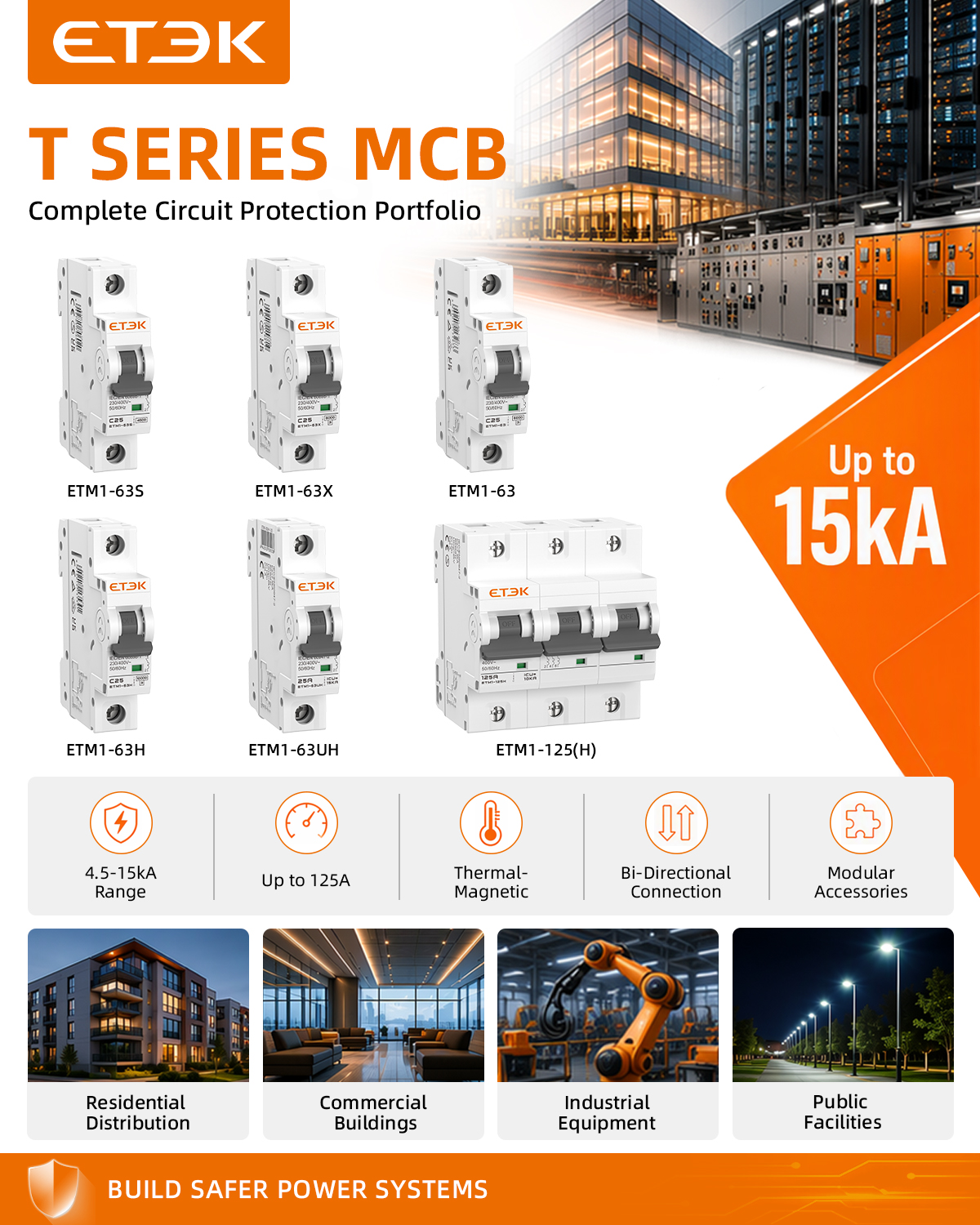
Current ratings and breaking capacity often get lumped together in spec sheets, but they answer two very different questions. A current rating tells you how much load a device can carry continuously without overheating or degrading under normal conditions. Breaking capacity, by contrast, describes the maximum fault current a protective device can interrupt safely—think short circuits and other abnormal surges that would otherwise destroy equipment or start a fire.
The confusion usually starts when someone picks a breaker based on its current rating alone and assumes it will handle any fault. In reality, a breaker rated for 20 amps continuous may need a breaking capacity of 6,000 or even 10,000 amps depending on the supply impedance and upstream transformer size. If the available fault current exceeds that limit, the breaker can weld its contacts closed or fail explosively, leaving the circuit unprotected.
A practical way to make sense of the pair is to treat current rating as a thermal budget and breaking capacity as an emergency brake. One is about steady state; the other is about surviving the worst-case instant. Checking both values against the actual installation—not just the nominal load—keeps routine operation efficient and rare fault events survivable.
How to Vet a Supplier Without Getting Lost in the Spec Sheets
Start by ignoring the glossy front page and flipping straight to the tolerance tables, material certifications, and QC process notes. A supplier that hides raw data behind marketing language is already telling you something. Compare the actual test results against what your project requires, not what looks impressive in a PDF. If a key spec is missing, ask for it directly — don't assume it will be fixed later.
Next, pick up the phone and ask three questions that can't be answered from a spec sheet: Who runs the final inspection? What happens when a batch fails? Can we see the rejection log from the last quarter? The way a supplier talks about failure reveals more than their claimed defect rate. A confident vendor will share the messy parts; a shaky one will change the subject.
Finally, request a sample from current production, not a gold-plated prototype. Send it to a third-party lab if the budget allows, or at least measure it yourself against the critical dimensions. Then watch how the supplier handles your feedback. Do they argue, go silent, or ship a corrected part with clear notes? That moment tells you more about the long-term relationship than any line item on a quotation.
The Certifications You Should Actually Look For
Most people treat certifications like trading cards—collect as many as possible and hope the pile looks impressive. That approach rarely works. The ones worth your time are issued by independent bodies that don't sell the training directly, and they force you to demonstrate actual skill under timed conditions.
Look for a few practical markers. Does the certifying organization have a code of ethics and a public registry of credential holders? Can anyone verify your certification number online? Is there a meaningful renewal process, not just a fee? These details separate a credential that opens doors from one that only decorates a resume.
Also, cross-check what hiring managers in your target field actually request. Spend ten minutes scanning job posts or talking to a couple of professionals. If the same three certifications keep appearing, those are the ones worth pursuing. Ignore the rest, no matter how shiny the acronym looks.
Keeping Bulk Costs Down Without Sacrificing Quality
Buying in larger quantities usually means chasing lower per-unit prices, but that pressure can quietly eat into the product itself if you're not careful. We've found that the real lever isn't just demanding a discount—it's sitting down with suppliers and asking where the material waste, over-spec packaging, or redundant handling actually lives. One supplier trimmed 12% off our landed cost just by switching to a lighter, equally protective inner carton that we never would have flagged without a line-by-line review.
Another move that worked well was consolidating orders around fewer, well-timed shipments instead of spreading purchases across many small lots. It sounds counterintuitive when cash flow is tight, but the freight savings and lower admin overhead more than made up for the slight increase in upfront spend. We also started using a simple scorecard that scores cost and quality side by side for every bulk purchase, so no one can quietly trade away a critical spec just to hit a number.
None of this requires cutting corners on materials or switching to flimsier components. It's mostly about asking better questions before the order goes in, and being willing to push back on hidden charges like rush fees or vague "handling" line items. The result is that our bulk unit cost has stayed flat or even dropped while the defect rate hasn't moved—which is the only metric that really matters at the end of the month.
Common Bulk Order Mistakes and How to Sidestep Them
Placing a bulk order can feel like a shortcut to savings, but many buyers stumble right out of the gate by skipping a detailed spec sheet. They fire off an email with a vague description, then wonder why the samples look nothing like the product page. Write down every tolerance, material grade, and finish before you even ask for a quote. That single habit prevents most miscommunication headaches later.
Another trap is chasing the lowest unit price without factoring in hidden costs like packaging, freight, or duty. A supplier might quote you a rock-bottom number, but then hit you with pallet fees you never saw coming. Ask for a line-item breakdown and compare total landed cost, not just the invoice total. It is the only way to know if that “bargain” actually saves you anything.
Finally, many buyers rush the pre-production sample stage because they are eager to lock in the order. They approve a photo or a quick video call, then find out the mass production run has loose threads or off-color dye. Insist on a physical sample shipped to your door, and test it the way your customers would use it. If anything feels off, pause the order. Fixing a sample costs days; fixing a container load costs your reputation.
FAQ
Start with the actual electrical specs, not just the price tag. For each breaker, check the rated current, number of poles, tripping curve, breaking capacity, and the standard it was tested to. If you skip any of these, you risk getting a batch that trips too early or fails during a short circuit. Ask the supplier for the full datasheet and compare it against the loads you plan to protect.
Match the curve to the inrush current of the connected load. B curve is for resistive loads like lighting and heating, C curve handles general distribution and small motors, and D curve is for high-inrush equipment like transformers or big motors. Buying the wrong curve is one of the most common reasons for nuisance tripping in the field, so it pays to mix your order based on real project needs rather than stocking only one type.
The breaking capacity tells you how much fault current the breaker can interrupt without destroying itself. For most residential and light commercial use, 6kA is fine, but industrial or large commercial panels often require 10kA or more. If you buy thousands of 6kA units for a high-fault-current site, you are creating a safety problem. Check the prospective short-circuit current at the installation point before you place a large order.
That depends on the market you are serving. IEC/EN 60898-1 is standard for most of Europe, Asia, and the Middle East, while UL 1077 or UL 489 is required in North America. Some manufacturers offer dual-certified MCBs, which can simplify your inventory if you ship to multiple regions. Always confirm what local electrical codes and inspectors will accept before committing to a bulk purchase.
Request free samples and physically inspect them: look at the terminal quality, case material, marking clarity, and trip lever feel. Ask for the supplier's batch test reports, ISO certifications, and any third-party test certificates. If the order size justifies it, visit the factory or ask for a video walkthrough of their production line. A supplier that cannot provide basic test data is not worth the risk, no matter how low the unit price is.
The biggest ones are mixing up AC and DC voltage ratings, ignoring busbar compatibility, forgetting to specify the number of poles, and not accounting for temperature derating. Some buyers also focus so hard on upfront cost that they ignore long-term failure rates and warranty support. Another frequent error is ordering too many unusual current ratings, which leaves you with dead stock while the commonly used ratings run out.
Direct from the manufacturer often gives you better unit pricing and room for custom labeling or packaging, but you may have to deal with high minimum order quantities and longer lead times. A distributor can offer smaller mixed orders, faster delivery, and localized support, which can be useful when you are testing a market. For steady wholesale volume, building a direct relationship with a factory you trust usually wins in the long run, provided you can handle logistics and quality control.
Look at your customer base first. If you sell mostly to residential electricians, focus on 6A to 63A single-pole and DP breakers with C curve. For commercial or industrial clients, add TP and 4P options in 10kA breaking capacity. Keep a small buffer of fast-moving items and only add niche ratings like 1A, 2A, or 80A when customers specifically request them. Overstocking odd ratings ties up cash and warehouse space without improving sales.
Conclusion
Bulk buying miniature circuit breakers is less about chasing the lowest unit price and more about matching each breaker to the actual load and the fault level it could face. The two numbers that genuinely matter are the rated current and the breaking capacity; a 16A breaker with a 6kA breaking capacity might be fine for a lighting circuit but dangerously under-specified near a main distribution board where prospective short-circuit currents run higher. When you sit down with a supplier, ask for batch test reports and a couple of production samples rather than relying on glossy datasheets. Look for IEC/EN 60898-1 or IEC/EN 60947-2 compliance, and in most markets you'll also want CE or UKCA marking. But certificates alone don't guarantee consistency, so check the physical markings, terminal torque behavior, and trip curve consistency across several units from the same carton.
On the cost side, the smartest way to keep a bulk order profitable is to negotiate payment terms, packaging, and shipping instead of squeezing the tariff per piece. A breaker that costs five cents less but has looser contacts or a sloppy calibration will create returns, inspection failures, or worse, field failures that erode your margin quickly. Common bulk order mistakes include ignoring temperature derating, mixing different breaking capacities in one order because a spec sheet looked similar, forgetting to confirm accessory compatibility like busbars and auxiliary contacts, and assuming lead times without buffer. Run a small pilot batch before committing to a full container, and keep a short checklist of actual measured trip times and resistance values. That discipline separates a repeatable wholesale purchase from a one-off gamble.
Contact Us
Contact Person: Andy
Email: [email protected]
Tel/WhatsApp: +86 13356133008
Website: https://www.etek-china.com/